FinOps Inform
Cloud data retention cost explained for UK CTOs
Discover what is data retention cost in the cloud and how to accurately calculate expenses. Optimize your budget and prevent governance failures.

Data retention cost in the cloud is the total ongoing spend generated by keeping data alive: storage (GB-month) plus every associated fee, including ingestion, replication, transaction requests, retrieval, egress, and query or scan charges. The single most important action you can take today is to calculate your steady-state stored GB using the formula GB/day × retention days, convert that to a GBP/month figure, and put it in front of finance. Most engineering teams budget only for incremental ingest and dramatically underestimate the true liability when retention windows expand, a pattern Microsoft's Well-Architected Framework explicitly flags as a governance failure. Koritsu AI sees this consistently across UK mid-sized and enterprise workloads on AWS, Azure, and GCP.
What does data retention cost in the cloud actually include?
Retention cost is not a single line on your bill. It is at least six distinct cost types, each driven by a different engineering decision.
- Storage (GB-month): the baseline charge for every GB sitting in a bucket or table, billed continuously for as long as the data exists.
- Ingestion and replication: raw ingest fees plus a replication multiplier. Three-region replication triples your effective storage footprint before compression is applied.
- Transaction and request costs: PUT, GET, DELETE, and lifecycle transition requests. High-churn datasets generate thousands of requests per hour.
- Retrieval and egress: pulling data out of archive tiers (S3 Glacier, Azure Data Lake cold tier) or moving it across regions carries per-GB fees that can dwarf the storage cost for infrequently accessed data.
- Query and scan costs: analytics engines such as Amazon Athena and BigQuery bill by data scanned, not rows returned. A single incident investigation across 90 days of unpartitioned logs can cost more than a month of storage.
- Minimum retention penalties: archive tiers carry minimum storage durations; S3 Glacier has a 90-day minimum. Delete an object before that threshold and you pay a pro-rated charge for the remaining days.
How to calculate your retention cost: a GBP worked example
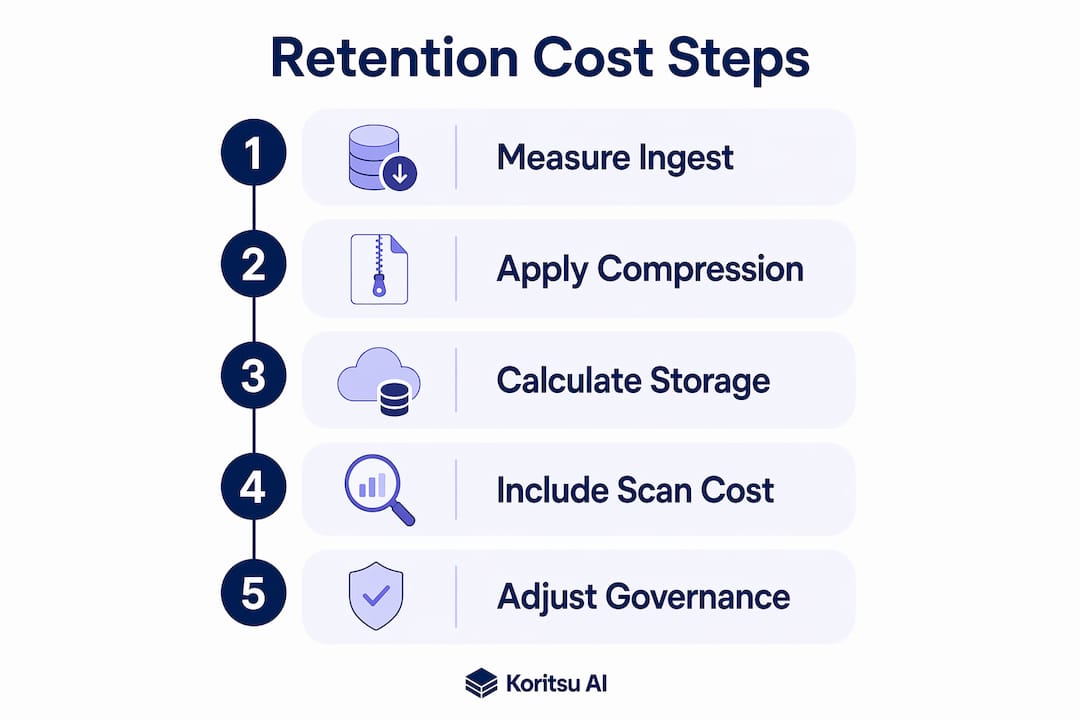
The steady-state model is the right starting point. Once ingestion is flat, stored GB stabilises at GB/day × retention days. Use the steps below, then plug your own numbers into a cloud hosting cost calculator to model GBP impact quickly.
- Measure average raw GB/day for the dataset or log stream (use billing export or a storage metrics dashboard).
- Apply a compression ratio (typically 3:1 for structured logs) and add index overhead (roughly 15–20%) to get effective GB/day.
- Compute steady-state stored GB = effective GB/day × retention days × replication factor.
- Multiply stored GB by the storage unit price ($/GB-month, converted to GBP) and add ingestion, query, retrieval, and egress lines.
| Input | Example value | Notes |
|---|---|---|
| Raw ingest | — | Measured from billing export |
| Compression ratio | 3:1 | Structured application logs |
| Index overhead | +15% | Search index on top of compressed data |
| Retention window | 90 days | Current policy |
| Replication factor | 3× | Three-region active replication |
| Steady-state stored GB | ~5,184 GB | — |
| Storage unit cost | storage unit price | converted to GBP |
| Monthly storage cost | — | 5,184 × $0.023 × 0.79 |
| Monthly query cost (est.) | — | query scan cost calculation |
| Monthly egress (est.) | — | cross-region replicated GB |
| Total monthly retention cost | ~£146 | Storage + query + egress |
Halving the retention window to 45 days cuts steady-state stored GB by half and drops the storage line to roughly £73. That single change saves approximately £73/month on storage alone, before touching query or egress.
Hidden operational costs that catch engineering teams off guard
Scan-cost spikes are the most underestimated line item in any retention budget. During a P1 incident, an on-call engineer running ad-hoc queries across six months of unpartitioned logs can generate a transient bill that exceeds the entire month's steady-state storage cost. Cloud infrastructure specialists describe retention as a hidden operational tax precisely because these peaks are invisible until the invoice arrives.

Early-delete penalties compound the problem. A 90-day minimum on S3 Glacier means that a backup set rotated every 30 days effectively pays for three months of storage per object, tripling the apparent cost of that tier. The same logic applies to Azure Blob Storage cool and cold tiers, which carry 30-day and 90-day minimums respectively.
Pro Tip: Model both steady-state monthly cost and incident-driven peak scan cost when presenting retention budgets to finance. Use partitioning by date and service as the primary lever to cap scan cost; it reduces scanned GB without touching retention policy.
How UK governance shapes your retention decisions
UK GDPR, enforced by the ICO, prohibits keeping personal data longer than necessary for its original purpose. That is not just a compliance obligation; it is a direct cost lever. Data you are not legally permitted to hold is data you should not be paying to store.
Microsoft's Well-Architected guidance frames retention as a business-priority decision, not a technical default. The practical implication: every dataset needs a documented retention justification, and that justification should set the minimum window, not the maximum.
Use this checklist when reviewing your cloud retention policy:
- Classify each dataset by data type (personal, financial, operational, security) and map it to the applicable UK GDPR or sector-specific retention requirement.
- Identify the business minimum: the shortest window that satisfies audit, legal hold, and operational needs.
- Document the retention justification in your data register and review it annually.
- Review cloud vendor contracts for minimum retention clauses and early-delete fees before changing tier or lifecycle policy.
- Align procurement on any contractual changes needed to avoid penalty charges.
A cloud spending governance framework that ties retention windows to documented business requirements prevents the data hoarding that inflates storage costs over time.
A practical FinOps playbook for reducing retention spend this quarter
Sequence these by ROI. Pilot with one service, measure the saving, then roll out.
- Reduce hot retention for low-value logs (debug, verbose application traces) from 90 days to 14–30 days. This is the fastest win and requires only a lifecycle rule change.
- Enable lifecycle rules on S3, Azure Blob, and GCS buckets to transition objects to infrequent-access or archive tiers after a defined period. Validate with mock runs before applying at scale to confirm projected savings and avoid unintended retrieval costs.
- Remove unnecessary cross-region replication in non-production environments. Three-region replication on a dev log bucket is a common and entirely avoidable cost.
- Implement date and service partitioning on query targets to cap scan costs. This is a medium-effort change with outsized impact on incident-investigation bills.
- Introduce structured logging and sampling for high-volume, low-signal streams. Reducing ingest volume directly reduces steady-state stored GB.
- Enforce retention deadlines via infrastructure-as-code so that policy changes propagate automatically rather than relying on manual bucket configuration.
Pro Tip: Track GB/day ingestion and steady-state stored GB as first-class engineering metrics alongside CPU and memory. When those numbers grow without a corresponding business justification, the cost follows automatically. See cloud infrastructure cost reduction strategies for a broader framework.
How to measure, attribute, and forecast retention spend
Accurate attribution starts with tagging. Every storage resource should carry tags for team, service, environment, and data sensitivity. Without those tags, you cannot allocate the £146/month example above to the team that owns the logs, and you cannot hold anyone accountable for reducing it.
Recommended metrics to track per dataset:
- Steady-state stored GB (updated daily from billing export)
- GB/day ingestion rate
- Queries/day × average GB scanned per query
- Egress GB/month by destination
- Retention days per dataset (compared against the documented business minimum)
For forecasting, the steady-state model is your baseline: if ingestion grows at 10% per month and retention stays fixed, stored GB compounds at the same rate. A dataset at 5,184 GB today reaches roughly 8,300 GB in six months with no policy change. Present that trajectory to finance alongside the GBP cost projection; it converts an abstract engineering metric into a budget line that demands attention. Cost allocation by team and service is the mechanism that makes this stick organisationally.
Set alerting thresholds for retention variance (stored GB growing faster than ingestion implies) and scan-cost spikes (query spend exceeding a defined daily ceiling).
Koritsu AI case study: cutting backup retention waste on AWS
A UK-based SaaS business was retaining nightly RDS snapshots and application backups across three AWS regions with no lifecycle policy and a default 90-day retention window applied uniformly to all environments, including development and staging.
Koritsu AI's engineering review identified that 68% of the stored backup volume was in non-production environments with no audit or compliance requirement. Lifecycle rules were introduced to reduce non-production retention to 7 days, cross-region replication was removed from dev and staging, and a tagging policy was enforced via Terraform. The result was a verified reduction in backup storage spend, with savings confirmed against AWS Cost Explorer billing data within the first 30 days.
The fix required no application changes. It was purely a lifecycle and governance correction, the kind of change that takes a week to implement but compounds in savings every month thereafter. The UK bidding platform case study shows a comparable pattern at larger scale, with a 52% reduction in overall cloud costs.
Key takeaways
Retention cost is a steady-state liability that compounds silently until you measure it, tag it, and enforce lifecycle rules against a documented business minimum.
| Point | Details |
|---|---|
| Calculate steady-state stored GB | Use GB/day × retention days × replication factor and convert to GBP/month for finance. |
| Tag every storage resource | Apply team, service, environment, and sensitivity tags to enable cost allocation and accountability. |
| Validate lifecycle rules before rollout | Mock-run lifecycle policies on AWS S3, Azure Blob, and GCS to confirm savings and avoid retrieval penalties. |
| Model scan-cost peaks separately | Incident-driven query spikes can exceed monthly storage cost; partition data by date and service to cap them. |
| Koritsu AI as FinOps partner | Koritsu AI combines AI-driven monitoring with hands-on engineering review to identify and fix retention inefficiencies on a success-fee basis. |
Why retention cost deserves a place on your engineering roadmap
Most organisations treat retention as a compliance checkbox. Set a policy, forget it, move on. The problem is that cloud billing does not forget. Every day you retain data beyond its business value, you pay for storage, replication, and the latent cost of scanning it during the next incident.
What durable change looks like is not a one-time cleanup. It is a process: classify data, set the minimum justified window, enforce it via infrastructure-as-code, and measure the result. Koritsu AI combines Kori, our AI agent that surfaces where money is being lost in your billing data, with hands-on FinOps specialists who help engineering teams execute the fix. The organisations that get this right treat retention cost as a first-class engineering metric, not a finance afterthought.
Koritsu AI can find and fix your retention waste
Most retention overspend is not caused by bad intentions. It is caused by default settings, absent lifecycle rules, and retention windows that were never reviewed after initial deployment. Koritsu AI gives UK engineering teams a clear picture of exactly where that waste sits, down to the dataset and team level, and then helps fix it.
The engagement starts with a free assessment. Koritsu AI's platform analyses your AWS, Azure, or GCP billing data and identifies your highest-impact retention inefficiencies. You pay only from the savings we verify, with no upfront commitment. For teams that want ongoing visibility, a SaaS subscription keeps Kori monitoring your storage footprint continuously. The UK bidding platform case study shows what a 52% reduction in cloud costs looks like in practice. To request your free retention cost review, visit koritsu.ai.
Useful sources and further reading
- Microsoft Azure Well-Architected Framework: data cost optimisation — the primary governance reference for lifecycle management, tiering, and retention alignment with business priority.
- Microsoft Sentinel data retention and tier management — detailed guidance on analytics tier vs. data lake tier retention costs and XDR data retention options.
- Amazon S3 pricing — official AWS storage class pricing, including request, retrieval, replication, and data management fees.
- Amazon S3 Glacier pricing — archive tier pricing including minimum storage durations and pro-rated early-delete charges.
- Backblaze: minimum data retention fees — clear explanation of how minimum retention periods can multiply backup costs.
- Log retention storage cost: steady-state GB-month explained — the steady-state formula and component breakdown used as the calculation basis in this article.
- ICO guidance on UK GDPR retention — the UK regulatory authority's guidance on lawful retention periods for personal data.