FinOps Inform
Why cloud projects exceed budget: the real causes
Discover why cloud projects exceed budget. Learn the key factors driving overspending and how to effectively manage costs for success.

Cloud projects exceed budget not because the technology fails, but because the organisation around it does. Industry analysis consistently shows that cost overruns stem from skills gaps, absent ownership, and billing surfaces that nobody modelled before go-live. A survey of 300 CIOs found that 83% overspent on cloud infrastructure by an average of 30%. The fix is rarely a new tool. It is process, discipline, and the right people owning the right numbers daily.
Why cloud projects exceed budget: the primary causes
The core reasons engineering teams face cloud budget overruns fall into three categories: hidden billing surfaces, over-provisioned infrastructure, and absent cost ownership.
- No standing cost owner. When nobody manages cloud spend as a daily job, waste compounds silently across dozens of engineers and hundreds of resources.
- Over-provisioning. Average cloud instance utilisation is 10–15%, meaning 85–90% of paid compute capacity sits idle and wastes money.
- Data egress charges. Costs for moving data between regions or providers are routinely excluded from migration budgets, then appear as surprises on the first post-migration invoice.
- Zombie resources. Test environments, orphaned volumes, and forgotten instances that nobody decommissioned. In many organisations, these account for a notable share of the total cloud bill.
- Metered API charges. A microservices architecture where 30 services each retrieve secrets on every request can generate millions of API calls per month from a component most engineers never consider billable.
- Skills and FinOps gaps. Cloud transformation failure is a people and leadership problem far more often than a technology one.
- Untagged resources. Without mandatory tagging and ownership rules, runaway costs have no clear owner and no clear stop.
Pro Tip: Data egress is architecturally invisible. Engineers design for reliability and latency, not for the $0.09/GB charge that accumulates every time traffic crosses a region or provider boundary. Model egress explicitly before any migration, not after.
Koritsu AI’s platform, Kori, surfaces exactly these patterns continuously, so your team sees where money is leaving before the invoice arrives.
What actually drives cloud budget overruns in practice
Consumption-based billing creates a cost surface that is genuinely hard to model upfront. Stable enterprise workloads pay a premium for burst-capable infrastructure they rarely use. Regulated industries face an additional layer: compliance, encryption, and audit logging requirements that generic migration budgets never account for. Vendor lock-in compounds this further, because reserved capacity commitments made in one provider cannot transfer if a workload moves mid-term.
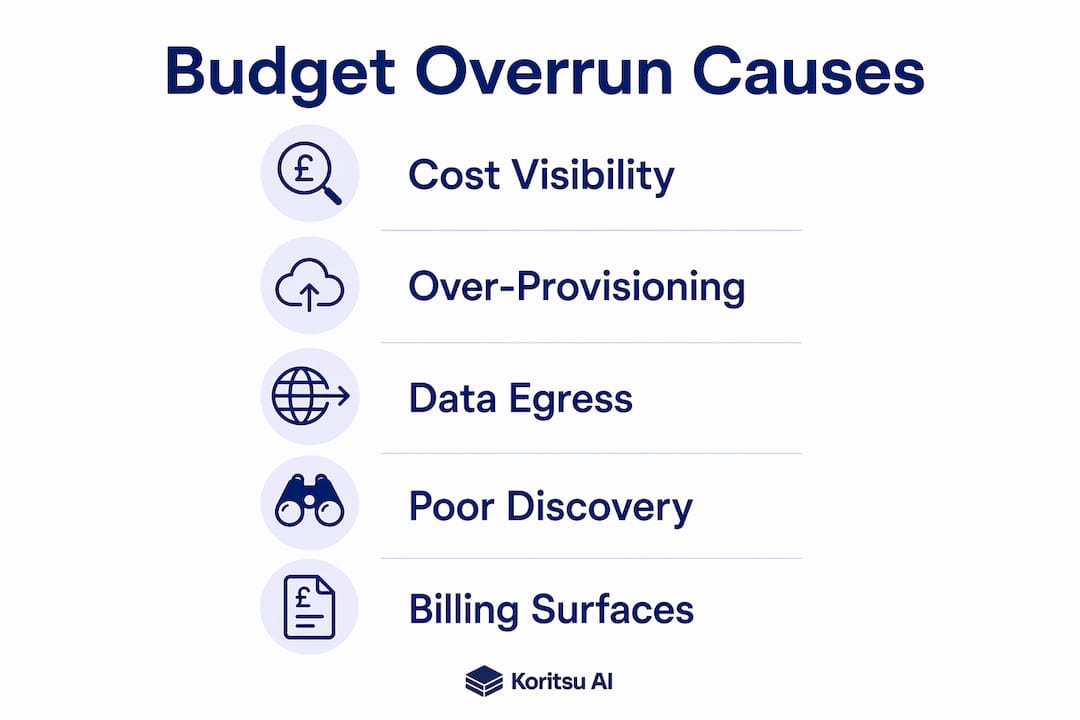
Poor pre-migration discovery is another consistent culprit. Assessments that rely on self-reported inventories undercount actual scope, and the remediation work surfaces mid-migration when it is most expensive to absorb. Understanding cloud total cost of ownership before committing to a migration scope is one of the most effective ways to close that gap. Clear cloud security shared responsibility models also matter here: ambiguity about who owns post-migration operations is a direct driver of unmanaged spend.

Budget overruns in UK companies: what the patterns show
A McKinsey survey of nearly 450 CIOs found that inefficiencies in cloud migration cost the average company 14% more than planned each year, with 38% of migrations delayed by more than one quarter. One global pharmaceutical company cut its cloud adoption scope by 50% and ended up spending 50% more than budgeted. UK organisations in financial services and healthcare face the same structural pressures, compounded by data sovereignty requirements and FCA or NHS compliance obligations that add scope nobody priced at the outset. The Capgemini research puts it plainly: 76% of organisations exceeded their public cloud budgets in the past 12 months, with a 10% average overrun.
How to optimise architecture and stop the overspend
Treating cloud cost as an engineering discipline rather than a finance report is where the real gains come from.
- Rightsize before you reserve. Downsize over-provisioned instances based on actual utilisation data, then commit to reserved pricing. Reserved instances or savings plans reduce compute costs by 30–60% for predictable workloads.
- Schedule non-production environments. Shutting down development and staging environments outside business hours saves roughly 65% of their running cost.
- Enforce mandatory tagging at resource creation. Effective cost governance requires each resource to have a named owner who can approve or stop overspending, not just a tag value in a spreadsheet.
- Treat overruns as operational incidents. Detect, attribute, and remediate unplanned spend in real time rather than catching it in a monthly review.
- Build egress into architecture decisions. Use VPC endpoints to avoid NAT gateway charges, co-locate services that exchange high data volumes, and model cross-region traffic before deployment.
- Embed FinOps skills in the team. Engineers who build the system should stay to operate it and own its cost as a standing responsibility, not a one-off audit task. A cloud cost culture guide for engineering teams covers how to build that discipline practically.
A cloud architecture cost review conducted before major releases catches the billing surface problems that accumulate silently between deployments.
Koritsu AI combines a continuously running AI platform with hands-on specialist advice to find the inefficiencies buried in how your infrastructure was built. Clients start with a free assessment, and Koritsu AI takes a share of the savings it actually finds. See how a UK bidding platform achieved a 52% reduction in cloud costs.
Key takeaways
Cloud projects most commonly exceed budget because of absent cost ownership, over-provisioned compute, and billing surfaces like data egress that were never modelled before go-live.
| Point | Details |
|---|---|
| Compute sits mostly idle | Average cloud instance utilisation is 10–15%, meaning that 85–90% of paid capacity generates no value. |
| Egress costs are invisible by design | Data transfer charges between regions and providers are documented but routinely excluded from migration budgets. |
| Ownership gaps drive runaway spend | Without a named owner per resource and mandatory tagging, overruns have no clear stop mechanism. |
| Reserved pricing cuts compute costs sharply | Savings plans reduce compute spend by 30–60% for stable workloads, but only when commitments match actual usage patterns. |
| Treat overruns as incidents, not reports | Real-time detection and attribution of cost spikes prevents the compounding waste that monthly reviews always catch too late. |