FinOps Inform
Cloud engineering efficiency best practices that actually cut spend
Discover ten cloud engineering efficiency best practices to optimize AWS, Google Cloud, or Azure, reducing costs and boosting performance.

The teams that get the most out of AWS, Google Cloud, or Azure share the same five habits: continuous rightsizing, infrastructure as code, real-time observability, FinOps-driven unit economics, and lightweight governance that stops sprawl before it starts. None of these are secret. They are the same ideas behind AWS Well-Architected’s performance efficiency pillar and Google Cloud’s operational excellence guidance. The gap between the companies that waste 30% of their cloud bill and the ones that don’t is execution, not knowledge.
This article breaks down ten cloud engineering efficiency best practices that engineering and DevOps leaders can put into action this quarter, not next year. Here’s what we cover:
- Rightsizing and autoscaling as a continuous discipline
- Cost management and FinOps, including unit economics
- Infrastructure as code, GitOps, and platform engineering
- Observability, SLOs, and data-driven optimisation
- Governance and standardisation through landing zones and guardrails
- Cloud-native architecture trade-offs (containers, serverless, microservices)
- Testing, resilience, and operational readiness
- Automation and AI for smart provisioning, with proper safety checks
- Developer workflows and CI/CD practices that bake in efficiency
- The cadence and culture that make optimisation stick
A 2026 systematic review found AI-driven techniques often deliver median cost or energy improvements of 30% to 40% in production-like studies, though the researchers flagged inconsistent validation methods across the studies reviewed. Treat that as a strong signal, not a guarantee.
Key Takeaways
Cloud engineering efficiency comes from continuous rightsizing, embedded FinOps discipline, and governance that’s automated rather than reviewed.
| Point | Details |
|---|---|
| Instrument unit economics | Calculate cost per request or active user weekly so cost becomes a product metric, not a finance report. |
| Rightsize on real data | Use billing, telemetry, and peak traffic, not averages, to set compute and storage sizing. |
| Automate governance | Enforce tagging, budgets, and guardrails as policy-as-code inside CI, not as manual reviews. |
| Validate AI recommendations | Canary and human-review any AI-driven provisioning change before it touches production capacity. |
| Get a free efficiency assessment | Koritsu AI’s continuous monitoring plus specialist delivery finds inefficiencies most internal audits miss. |
1. Rightsizing and autoscaling: continuous optimisation of compute and storage
Rightsizing isn’t a one-off audit. It’s a loop that runs on billing data, telemetry, and business metrics together, because CPU utilisation alone tells you almost nothing about whether a workload is actually oversized. AWS’s Well-Architected guidance is explicit on this point: factor cost into the architectural decision itself, and use benchmarking data rather than guesswork to choose the right compute and storage tier.
Three things separate teams that rightsize well from teams that just resize once and forget it:
- Pull data from billing exports, APM telemetry, and custom business metrics (orders processed, jobs completed) rather than CPU/memory averages alone.
- Choose autoscaling triggers deliberately: utilisation-based scaling works for steady-state services, but p99 latency or queue depth often reflects real user pain better.
- Set conservative cooldown periods and hard upper/lower bounds so autoscaling doesn’t flap during traffic spikes or silently under-provision at 3am.
Storage tiering is the fastest win most teams ignore. Lifecycle rules that move cold data to cheaper tiers after 30 or 90 days often cut storage spend without touching a single line of application code.
Pro Tip: Run your rightsizing review against last month’s peak traffic, not last month’s average. Average-based rightsizing is how teams end up paging on-call at the exact moment they saved the most money.
2. Cost management and FinOps: unit economics, tagging, and showback
Cloud cost stops being an abstract line item the moment you can express it as cost per request, cost per order, or cost per active user. That’s the core discipline behind cloud unit economics and it’s what turns a finance conversation into an engineering one.
- Calculate unit costs. Divide total infrastructure spend for a service by a meaningful business volume metric, then track the trend weekly, not quarterly.
- Tag everything, enforce it in CI. A tagging policy that isn’t enforced at deploy time decays within weeks. Build the check into your pipeline, not into a quarterly spreadsheet exercise.
- Build showback and chargeback dashboards. Teams that can see their own cost per transaction change their own behaviour faster than any top-down mandate ever will.
- Add automated budget gates. Fail a pull request, or at least flag it loudly, when a proposed infrastructure change is forecast to breach a service’s monthly budget.
High-performing teams treat unit economics as a product metric, not an IT metric. Pairing that discipline with DORA metrics gives you both sides of the equation: how fast you ship, and what it costs to run what you shipped.
3. Infrastructure as code, GitOps, and platform engineering
Standardisation is what stops ten teams from building ten slightly different, slightly wasteful versions of the same VPC. Practitioner guidance is consistent on this: shared IaC modules and policy-as-code baked into pipelines reduce both variance and hidden operational cost, because governance stops being a review meeting and becomes a delivery capability.
Three practices make this stick:
- Build modular IaC libraries (Terraform modules, CDK constructs) with sensible cost and security defaults baked in, so teams have to actively opt out of efficiency rather than opt in.
- Run GitOps flows that detect configuration drift automatically and require pull requests for any change to production infrastructure, closing the gap between what’s declared and what’s running.
- Invest in an internal platform with paved paths. Teams adopt efficient patterns far faster when the “default” path is also the cheapest and most secure one.
Snowflake environments, the ones nobody can explain or safely tear down, are usually the single most expensive line item nobody has actually costed. Standardised automation for engineering leaders is the fix, and it compounds: every new service built on the platform inherits the efficiency work already done.
4. Observability, SLOs, and data-driven optimisation
You can’t optimise what you can’t see, and most teams see less than they think. Google Cloud’s operational excellence guidance puts SLO-driven operations and automation at the centre of managing cost and reliability together, rather than treating them as competing priorities.
- Collect the golden signals (latency, traffic, errors, saturation) alongside business metrics like conversion rate or job completion time.
- Set SLOs with real error budgets, and let burn-rate breaches, not gut feel, drive release and rollback decisions.
- Set retention policies deliberately: keep high-resolution metrics for two weeks, downsample after that. Full-resolution logs kept for a year rarely earn their storage cost.
- Build dashboards that correlate cost anomalies with deploy events and incidents, so a spend spike is diagnosed in minutes, not discovered at month-end.
Pro Tip: If your observability stack costs more per month than the incidents it prevents, that’s not a resilience investment, it’s a second cloud bill hiding inside the first one.
5. Governance and standardisation: landing zones, CCoE, and guardrails
Governance done badly slows everyone down with approval queues. Governance done well is invisible, enforced automatically, and lets teams move faster because they never have to ask permission for a decision that’s already been made safe by default.
- Build a landing zone blueprint. Standard account structure, networking, and identity baselines that every new workload inherits on day one.
- Stand up a cloud centre of excellence (CCoE). A small, cross-functional group that owns guardrails, reviews exceptions, and keeps standards current, rather than gatekeeping every deployment.
- Enforce guardrails as policy-as-code. Identity permissions, allowed regions, and permitted instance classes should be enforced automatically, not documented in a wiki nobody reads.
- Review and prune guardrails quarterly. Standards that don’t evolve become the excuse teams use to build outside the platform entirely.
Standardisation isn’t bureaucracy for its own sake. It’s what lets a 200-engineer organisation ship as autonomously as a 20-engineer one, without the operational risk that autonomy usually brings.
6. Cloud-native architecture patterns: containers, serverless, and microservices
Every architecture decision is a cost decision, whether or not anyone frames it that way. Containers give you portability and predictable cost at steady, high-volume load. Serverless gives you near-zero idle cost but can get expensive fast at high, constant throughput, since you’re paying a premium per invocation rather than for reserved capacity.
- For steady, predictable workloads, container-based compute with reserved or committed-use pricing usually beats serverless on raw cost.
- For spiky, unpredictable, or low-frequency workloads, serverless keeps idle cost near zero and removes capacity planning entirely.
- Keep state out of compute wherever possible; externalise it to managed databases or object storage so scaling decisions don’t get tangled up with data consistency risk.
- Watch for the classic serverless trap: a function that’s individually cheap but called millions of times a day at a per-invocation cost that quietly outpaces what a small reserved instance would have cost.
Hybrid designs, serverless for bursty edge workloads and containers for the steady core, often outperform an all-in bet on either pattern.
7. Testing, resilience, and operational readiness
Incidents are expensive twice over: once in engineering time, and again in the emergency scaling and over-provisioning teams reach for afterwards to avoid a repeat. Resilience testing is what prevents both costs.
- Run small, scheduled game days. Start with a single, well-understood failure mode (a dependency timeout, a region blip) in a controlled window, not a surprise Friday-afternoon chaos experiment.
- Load test before committing to expensive architecture. Multi-region active-active setups look great on a slide; model the real cost-per-nine of availability before you build one.
- Use immutable deployments with fast rollback. The teams that recover from incidents in minutes, not hours, are the ones that never patch a running instance, they replace it.
Pro Tip: Cost-impact modelling before a multi-region build is cheap. Discovering the real cross-region data transfer bill after launch is not.
8. Automation, AI, and smart provisioning: safe uses and limits
AI-assisted provisioning has moved well past the hype phase, but the evidence comes with real caveats. The Frontiers systematic review found predictive provisioning and metaheuristic algorithms often deliver 30% to 40% cost or energy improvements, but flagged validation gaps and heterogeneous testing methods across the studies it examined. Treat published gains as directionally encouraging, not as a number you can promise your board.
- Predictive provisioning and ML-based autoscalers can anticipate load ahead of demand, cutting both over-provisioning and scaling lag.
- A newer approach, “cloud oracles,” precomputes optimal configurations offline and selects them deterministically online, sidestepping some of the explainability and drift issues that plague live-trained ML autotuners.
- Never let an automated system make an unreviewed change to production capacity. Canary the recommendation, require a human sign-off above a defined blast radius, and keep a one-click rollback ready.
Explainability isn’t a nice-to-have when a model is deciding your production capacity. A recommendation you can’t explain is a recommendation you can’t safely act on, no matter how good its average performance looks in a research paper.
9. Developer workflows and CI/CD practices that embed efficiency
Efficiency that depends on a quarterly review will always lose to efficiency built into the pipeline every engineer touches daily. That’s the real lesson from teams running high-scale platforms: cost checks belong in CI, not in a separate FinOps meeting three weeks after the spend already happened.
- Add infrastructure cost checks as CI gates. A Terraform plan that increases a service’s forecast spend beyond a threshold should fail the build, or at minimum require explicit approval.
- Adopt trunk-based development with ephemeral environments. Short-lived preview environments that tear themselves down automatically eliminate the “forgotten staging cluster” tax almost every organisation carries.
- Use progressive delivery. Canary and blue-green releases catch cost and performance regressions before they hit 100% of traffic, not after.
- Standardise pipeline templates with artefact provenance. Knowing exactly what built what stops the accidental duplicate deployments that quietly double a service’s footprint.
Small, frequent changes are cheaper to diagnose and cheaper to roll back than infrequent, large ones. That’s a delivery principle and a cost principle at the same time.
10. Continuous optimisation cadence and cost-aware engineering culture
Optimisation that happens once a year decays within a quarter. The organisations that keep their cloud efficient treat it as a cadence, with named owners, not a project with an end date.
- Run rightsizing reviews monthly and tagging audits quarterly; both drift faster than most leaders expect.
- Review SLOs and error budgets alongside cost data in the same meeting, so trade-offs get made deliberately instead of by accident.
- Track unit economics and DORA metrics together as your core KPI set; a team shipping fast but burning cash per transaction isn’t actually efficient.
- Fold cost ownership into engineering performance conversations, not just platform-team dashboards, so the incentive to optimise sits with the people who can act on it.
Culture change here isn’t abstract. It’s the difference between an engineer who checks a cost dashboard because they’re curious and one who checks it because it’s part of how their work gets judged.
Koritsu perspective: how continuous AI analysis and expert delivery find buried inefficiencies
Most of the practices above work. The problem for busy engineering teams isn’t knowing what to do, it’s finding the time and the specific evidence to act on any given service, buried as it usually is somewhere in a six-figure monthly bill across hundreds of resources.
That’s the gap Koritsu AI was built to close. Our AI agent, Kori, runs continuous analysis across your AWS, Google Cloud, or Azure spend, surfacing exactly where inefficiency is hiding, whether that’s an oversized instance family, an unpruned storage lifecycle policy, or an architecture pattern that made sense two years ago and doesn’t anymore. Specialists then work directly with your engineers to fix the root cause, not just flag the symptom.
A few things make this model different from a generic dashboard tool:
- We charge as a share of the savings we actually verify against your billing, not a flat licence fee for a tool you have to operate yourself.
- Engagements start with a free assessment, so you see the specific findings before committing to anything.
- Continuous AI monitoring means new inefficiencies get caught as your architecture evolves, not just at the point of a one-off audit.
- This complements the practices above; it doesn’t replace your rightsizing reviews or your platform team, it accelerates them with evidence they’d otherwise spend weeks finding manually.
Kori’s take: prioritise engineering outcomes over raw savings
If you take one thing from this article, make it unit economics. Every practice above, rightsizing, IaC, observability, governance, eventually shows up as a change in cost per request or cost per active user. Track that number and the rest becomes easier to prioritise.
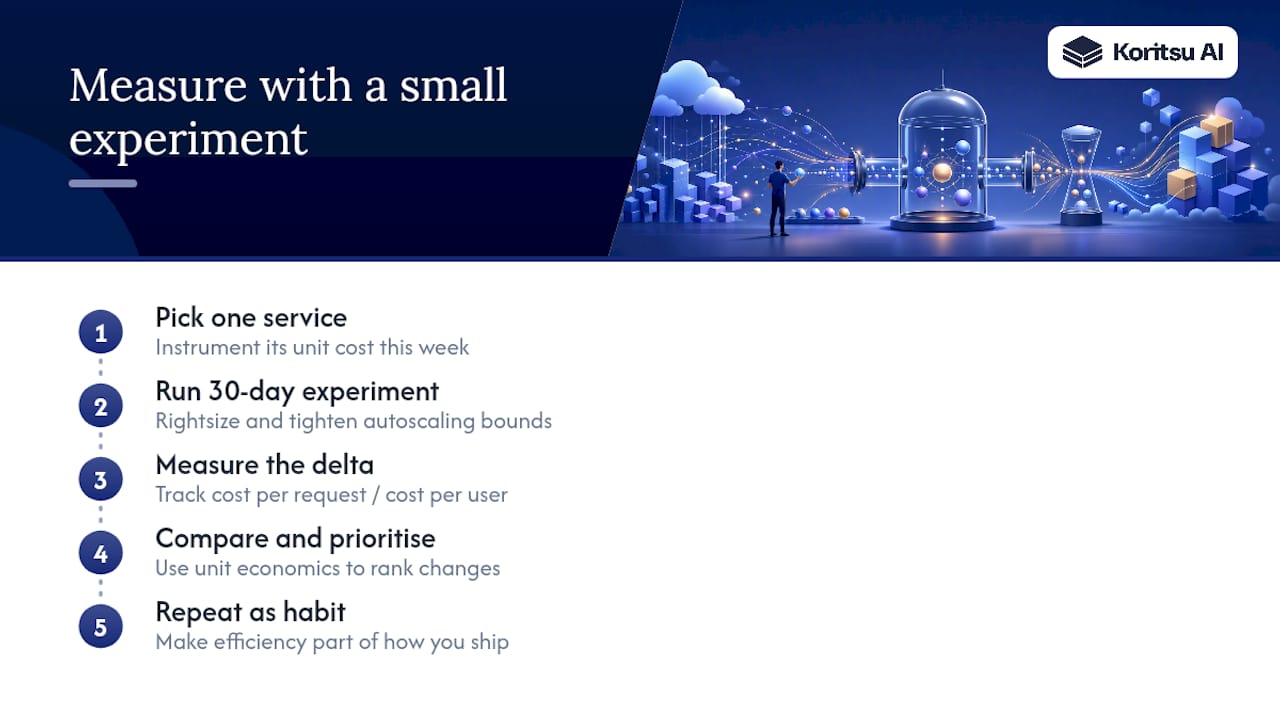
Start small. Pick one service, instrument its unit cost this week, and run a 30-day experiment: rightsize it, tighten its autoscaling bounds, and measure the delta. You’ll learn more from that one experiment than from a company-wide audit that takes three months to report back.
Efficiency isn’t a project you finish. It’s a habit you either build into how your team ships, or you don’t.
How Koritsu can help
Everything in this article is something your team can implement directly. The honest constraint is usually time: finding which specific service, tag, or architecture pattern is actually costing you money takes hours most engineering teams don’t have spare.
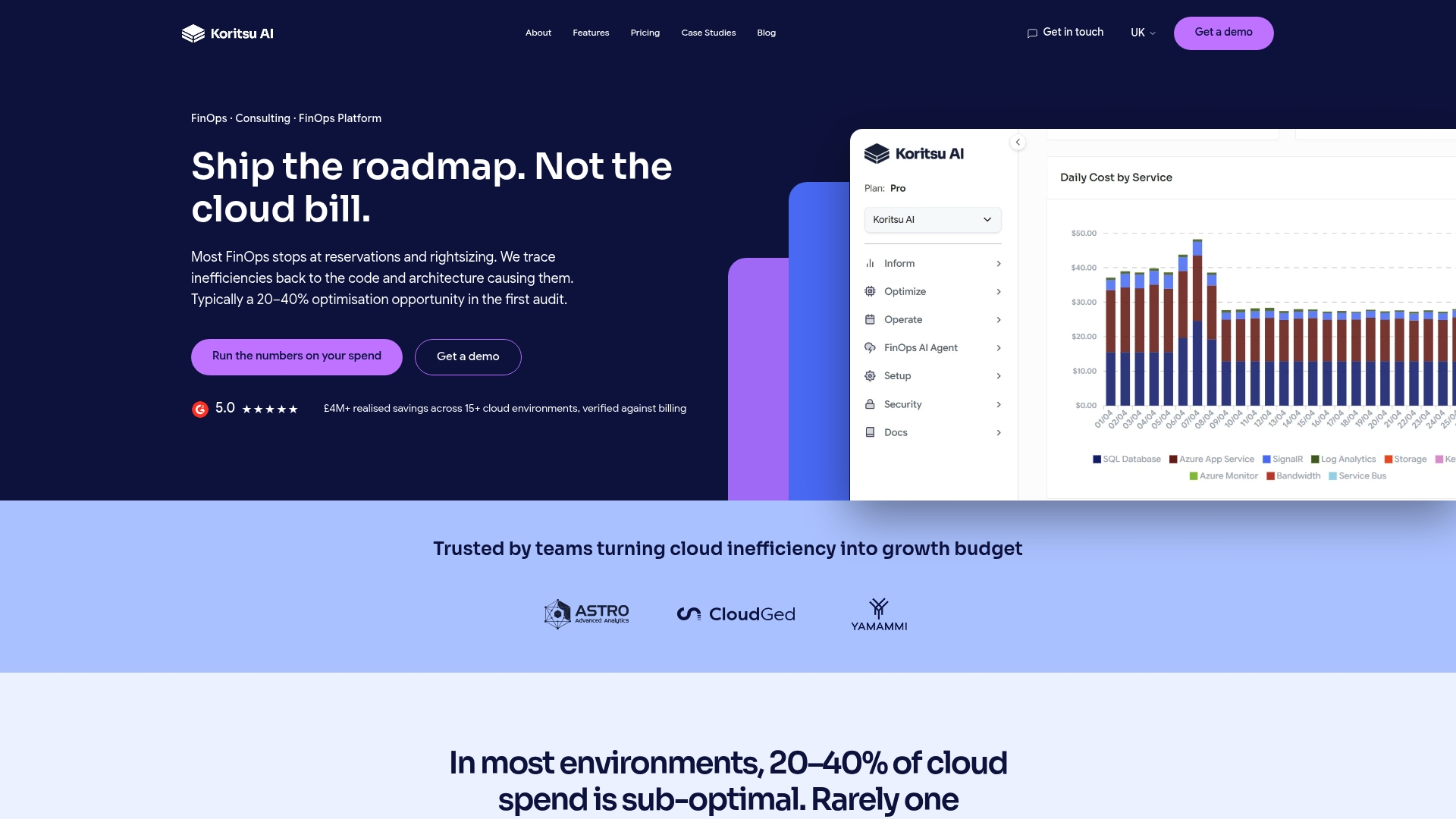
Koritsu AI exists to close that gap without adding headcount. Kori runs continuous analysis across your cloud spend and surfaces exactly where the money’s going that shouldn’t be, then our specialists work alongside your engineers to fix the root cause. You only pay a share of the savings we verify, and every engagement starts with a free assessment so you see real findings before you commit to anything further. If your cloud bill has been climbing faster than your traffic, start with a free assessment at Koritsu AI and see what’s actually driving it.
Sources
- AWS Well-Architected Framework: Performance efficiency pillar
- Google Cloud operations and architecture framework
- AI-driven optimization in cloud computing: a systematic review of cost, resource management, and security (Frontiers, 2026)
- Optimizing the cloud? Don’t train models. Build oracles (CIDR/VLDB paper, 2024)
- Why standardization is becoming the biggest accelerator for cloud engineering (DEV Community)