FinOps Inform
Reduce cloud vendor lock-in costs: a guide for engineering leaders
Discover eight practical actions to reduce cloud vendor lock-in costs. Start cutting expenses and lowering risk this week!

Eight actions you can start this week to reduce cloud vendor lock-in costs and lower your exposure immediately:
- Audit your top five highest-egress workloads and flag any bucket or data pipeline transferring more than 1 TB per month out of a single provider.
- Request an egress waiver clause in your next renewal or enterprise discount programme (EDP/MACC) negotiation — providers will often grant a migration window with zero or reduced egress fees if you ask before signing.
- Enable cross-region object replication to an S3-compatible store (such as MinIO) for your most data-heavy buckets; this reduces egress costs during any future migration and gives you a live alternative endpoint today.
- Containerise at least one critical workload using Kubernetes this quarter; this is the single highest-leverage architectural change for long-term portability.
- Run an inventory of proprietary managed services your teams use (provider-specific serverless, proprietary queues, managed ML pipelines) and score each by how hard it would be to replace.
- Review your committed-use or reserved-instance contracts for deconversion clauses and exit windows before the next renewal date.
- Adopt Terraform or OpenTofu for all new infrastructure provisioning; stop writing provider-specific CloudFormation or Bicep templates for net-new workloads.
- Assign a named owner for cloud portability as a regular KPI, reported alongside cost and reliability metrics.
The actions that reduce immediate cash outflow are the egress audit, the egress waiver request, and the object-storage replication. The rest reduce long-term migration liability, which is where the larger financial exposure usually sits.
Pro Tip: Most engineering leaders prioritise code portability. The operational layer — IAM policies, IaC templates, monitoring pipelines, and runbooks — typically accounts for more migration hours than application code. Audit your operational surface first.
What cloud vendor lock-in actually costs UK organisations
Cloud vendor lock-in is not a single problem. It is four overlapping problems, each of which shows up differently on your financial statements.
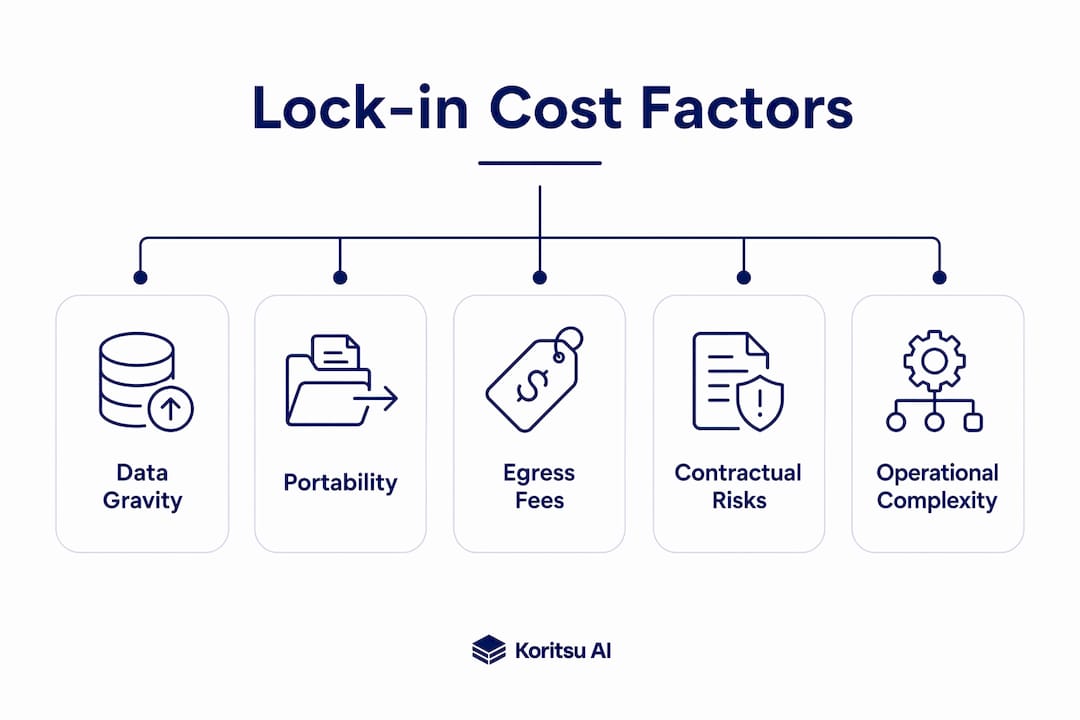
Technical lock-in occurs when workloads depend on proprietary services with no open equivalent: AWS Lambda with provider-specific event sources, Azure Cognitive Services APIs, or Google’s proprietary BigQuery ML. Data lock-in is the gravitational pull of large datasets stored in a provider’s object store or warehouse, where egress fees can represent a notable portion of monthly cloud spend and grow with every quarter you delay portability work. Contractual lock-in comes from committed-use discounts, enterprise agreements, and minimum-spend clauses that make leaving financially painful before the term ends. Organisational lock-in is subtler: your team’s runbooks, certifications, and muscle memory are all provider-specific, so even a technically portable workload carries a retraining cost.
Each vector maps to a real cost line. Egress fees appear directly on your monthly bill. Migration labour — re-engineering proprietary services, rewriting IaC, retraining staff — is a capital cost that grows exponentially with delay. Parallel-running costs, where you operate on two providers simultaneously during a migration, can run for months. Lost negotiating leverage is the least visible cost: a provider that knows you cannot leave has little incentive to offer competitive pricing at renewal.
For UK organisations, there is an additional regulatory dimension. The UK GDPR and the ICO’s data portability guidance give individuals and, increasingly, organisations grounds to demand data in portable formats. Storing data in proprietary formats or in a single provider’s ecosystem creates compliance risk alongside commercial risk. GOV.UK’s guidance on managing technical lock-in explicitly recommends that public sector and regulated organisations assess portability as part of procurement.
Vendor lock-in is a structural asymmetry: providers price knowing a workload’s portability score. Buyers who cannot quantify their exposure negotiate from weakness.
Engineering tactics that cut long-term lock-in costs
The most cost-effective portability work is the kind you do before you need to migrate. Building on open primitives from the start costs a fraction of refactoring later, and the multi-cloud payback from competitive pricing leverage typically arrives within a couple of years.
Prioritise patterns by cost impact and implementation effort:
- Containers and Kubernetes for compute portability — the highest-leverage single change, with a well-established skills market in the UK.
- Open data formats (Parquet, Apache Iceberg) for analytics workloads — both a portability measure and, for UK and EU teams, increasingly a regulatory control under data portability regimes.
- S3-compatible object storage (MinIO or equivalent) as an abstraction over provider-native buckets — enables low-egress alternatives for data-heavy workloads.
- Terraform or OpenTofu for infrastructure-as-code — provider-agnostic modules that reduce drift and make re-provisioning on a second cloud a matter of days, not months.
- OpenTelemetry for observability — a vendor-neutral instrumentation standard that prevents your monitoring stack from becoming a migration blocker.
- Crossplane for platform abstraction — lets platform teams expose a single API surface to developers while the underlying provider remains swappable.
The honest trade-off: open primitives are almost always less feature-rich than their managed proprietary counterparts. AWS Aurora is faster to operate than self-managed PostgreSQL on Kubernetes. Azure Service Bus has richer dead-letter tooling than a self-hosted RabbitMQ. The question is not whether proprietary services are better — often they are — but whether the operational convenience is worth the switching cost at your data volumes and contract exposure. For AI workloads specifically, ML pipelines and GPU orchestration are among the most provider-specific and expensive dependencies to replicate, so they deserve early portability scoring.
Pro Tip: The operational surface — IAM roles, secrets management, monitoring pipelines, and IaC state files — is where most migration hours actually go. Use Crossplane or a platform catalogue to abstract these from day one, and you will halve the engineering effort of any future move.

| Strategy | Cost-to-move | Ongoing egress | Portability | Operational complexity | Regulatory impact | Time to migrate |
|---|---|---|---|---|---|---|
| Kubernetes for compute | Medium | Low | High | Medium | Positive (data residency control) | — |
| Parquet / Iceberg for analytics | Low | Low | High | Low | Positive (UK GDPR portability) | 2 weeks |
| S3-compatible object storage | Low | Low–medium | High | Low | Neutral | 1 week |
| Terraform / OpenTofu IaC | Low | None | High | Low | Neutral | 2 weeks |
| OpenTelemetry observability | Low | Low | High | Low | Neutral | 2 weeks |
| Proprietary managed DB (retain) | High | High | Low | Low | Negative (format dependency) | 3 months |
Procurement and contract tactics that preserve your exit options
Commercial levers are often faster to act on than architectural changes. A single clause negotiated before signing can be worth more than months of refactoring work.
Specific protections to request in every cloud contract:
- Egress waiver for migration windows: ask for zero or reduced egress fees during a defined transition period (typically 90–180 days) if you give notice of intent to migrate.
- Data export assistance: a contractual commitment that the provider will assist with bulk data export in an open format within a defined SLA.
- Transition assistance period: a post-termination period (often 30–90 days) during which the provider continues to operate your workloads at current pricing while you complete migration.
- Audit and certification rights: the right to validate that your data has been fully deleted from provider infrastructure post-migration, which matters for UK GDPR compliance.
- Deconversion clauses in enterprise agreements: explicit language defining the process and cost of exiting a committed-use contract early, including any forfeited discount recovery.
The committed-use trade-off deserves particular attention. Enterprise discount programmes — AWS EDPs, Azure MACCs, Google CUDs — offer genuine savings that can reduce cost against list price, but they create a financial moat. The longer the term and the higher the minimum spend, the more leverage you surrender at the next renewal. Structure commitments to preserve bargaining power: shorter initial terms with renewal options, spend floors rather than service-specific commitments, and explicit exit windows at 12-month intervals.
Before any EDP or MACC negotiation, quantify your lock-in exposure as a number. Sum your estimated engineering hours to migrate, your monthly egress costs annualised, and your parallel-running estimate. That figure is your walk-away cost, and it is the most powerful input to a negotiation. Providers know it; you should too. For more on structuring these conversations, the cloud contract negotiation guide from Koritsu AI covers the specific language and sequencing that works.
Pro Tip: Trade non-price concessions for lock-in reduction. If a provider will not move on headline discount percentage, ask for transition assistance, egress waivers, and a shorter initial term instead. These can often be more valuable than small percentage discounts off list price.
How to measure lock-in exposure and rank workloads by savings potential
Lock-in is a quantifiable liability, not a vague risk. The goal is to produce a number that finance can put on a balance sheet and that you can use to prioritise engineering effort.
Score each workload across five dimensions:
- Portability score (1–5): how many proprietary APIs, managed services, or provider-specific data formats does this workload use?
- Data gravity (1–5): how much data does this workload store and transfer out per month?
- Business criticality (1–5): what is the revenue or operational impact of this workload being unavailable during migration?
- Egress volume: actual monthly egress in GB/TB, pulled from your billing console.
- Contractual exposure: months remaining on committed spend that covers this workload.
Multiply portability score by data gravity to get a raw lock-in score. Weight by egress volume and contractual exposure to produce a lock-in liability estimate. For finance, convert engineering hours to a day-rate cost and add egress costs and parallel-running estimates to produce a total cost-to-move per workload.
| Workload | Portability score | Data gravity | Egress (TB/mo) | Contract months remaining | Lock-in liability (£) | Priority |
|---|---|---|---|---|---|---|
| Analytics pipeline | — | 5 | 12 | — | High | 1 |
| ML training jobs | 5 | — | 2 | — | High | 2 |
| API gateway layer | 2 | 1 | — | 2 | Low | 5 |
| Object storage (media) | 3 | 5 | — | 12 | High | 3 |
| Microservices (containerised) | 1 | 2 | 1 | 2 | Low | 2 |
| Data warehouse | — | — | — | — | High | — |
Practical prioritisation rules: start with high-data, high-egress workloads where the monthly cost is visible and the migration payback is fastest. Avoid low-value migration targets — a small internal tool on a proprietary runtime is rarely worth the engineering effort. Workloads already on Kubernetes with open data formats can often be deprioritised; the cloud TCO model matters more than the portability score alone when the switching cost is already low.
Migration strategies, realistic timelines, and what drives the cost
There is no single right migration approach. The choice depends on how much proprietary surface area a workload has, how much data it holds, and how much engineering capacity you can commit.

Rehost (lift-and-shift) is the fastest approach and the cheapest in engineering hours, but it rarely reduces lock-in because you carry proprietary dependencies with you. It makes sense when you are moving between providers for contractual reasons and plan a second-phase refactor. Replatform replaces specific proprietary services with open equivalents — swapping a provider-native queue for a self-managed Kafka cluster, for instance — without rewriting application logic. This is the most common cost-effective path for UK organisations with medium data volumes. Refactor is the most thorough approach: redesigning workloads to use open primitives throughout. It costs the most upfront but produces the lowest ongoing lock-in liability. Hybrid active-active, running workloads simultaneously on two providers, is appropriate for high-availability requirements but carries the highest parallel-running cost and operational complexity.
Major cost contributors in any migration:
- Data egress fees during the transfer window (often the largest single line item for data-heavy workloads).
- Re-engineering of provider-specific services: replacing proprietary event sources, managed ML tooling, or native identity services.
- Parallel-running costs: operating on both providers during cutover and verification, which can last weeks to months.
- Retraining and tooling changes: new runbooks, updated CI/CD pipelines, and provider-specific certification gaps in the team.
A short preparatory checklist before you start: run a small test migration of a non-critical workload to validate egress behaviour and export formats; confirm that your data export meets UK GDPR requirements for format and completeness; validate that Terraform state can be re-targeted to the destination provider; and check that your observability stack (ideally OpenTelemetry-based) will work without modification on the destination.
Moving from hyperscaler storage to alternative object storage can produce substantial annual savings for data-heavy workloads, particularly when egress fees are replaced with flat-rate or zero-egress pricing models. For cloud security considerations during migration, cloud security best practices are worth reviewing alongside your portability planning.
The tools and open standards that make portability practical
The canonical open standards for reducing lock-in are well-established. The question for most UK platform teams is not which ones to adopt but in what order, and how to prevent proprietary drift once they are in place.
- Kubernetes: the standard for portable compute. AWS (EKS), Microsoft Azure (AKS), and Google Cloud Platform (GKE) all offer managed Kubernetes, meaning a well-structured workload can move between them with configuration changes rather than code rewrites. The UK has a strong Kubernetes skills market, which reduces the organisational lock-in risk.
- Terraform / OpenTofu: provider-agnostic infrastructure-as-code. Standardising on Terraform and open data formats keeps the delivery layer portable and lowers long-term switching costs. OpenTofu is the open-source fork with no licensing constraints, which matters for organisations concerned about HashiCorp’s BSL licence change.
- Apache Parquet and Apache Iceberg: the open columnar storage formats for analytics. Parquet is widely supported across AWS Athena, Azure Synapse, and Google BigQuery. Iceberg adds table-format semantics (schema evolution, time travel, partition pruning) that make it the better choice for large, frequently updated analytical datasets.
- MinIO: an S3-compatible object store that runs on any infrastructure. Using MinIO as an abstraction layer means your application code targets the S3 API, not a provider-specific SDK, and the underlying storage location becomes a configuration choice.
- Crossplane: a Kubernetes-native control plane for provisioning cloud resources via open APIs. It lets platform teams expose a curated catalogue of infrastructure primitives to developers without exposing provider-specific APIs directly.
- OpenTelemetry: the CNCF standard for metrics, logs, and traces. Instrumenting with OpenTelemetry means your observability data is not tied to a provider-native monitoring service, which is one of the most commonly overlooked migration blockers.
Pro Tip: Build a platform catalogue that exposes exactly six primitives: object store, relational database, cache, queue, secrets vault, and observability. Back each with an open-standard implementation. Developers who cannot find a proprietary shortcut in the catalogue are far less likely to create one.
For UK organisations in regulated sectors, open formats and standard orchestration are increasingly both a portability measure and a compliance control. The EBA’s outsourcing guidelines and the ICO’s data portability requirements both push in the same direction: documented, auditable, exportable data in standard formats.
“Organisations should consider portability and interoperability requirements from the outset of any cloud procurement, not as an afterthought.” — GOV.UK guidance on managing technical lock-in in the cloud
When to bring in an external specialist
Internal teams can handle portability work incrementally. But there are specific situations where external help pays back faster than the cost of the engagement.
Clear triggers for bringing in a specialist:
- You have more than 50 TB of data in a single provider’s object store or warehouse and a contract renewal within 12 months.
- Your committed-use contract has a minimum-spend clause you are at risk of breaching, or you are approaching a renewal with no quantified walk-away position.
- Your platform team has fewer than three engineers with hands-on Kubernetes and Terraform experience across multiple providers.
- You have received a significant price increase at renewal and have no credible alternative to present in negotiation.
A credible independent assessment should deliver four things: a quantified lock-in liability per workload (engineering hours, egress costs, parallel-running estimates); a prioritised migration roadmap with realistic timelines and cost-to-move per workload; specific contract clause recommendations for your next renewal; and a migration cost model that finance can use to approve budget. Anything less is a slide deck, not an assessment.
Engagement models vary. Time-and-materials advisory is common but creates misaligned incentives — the consultant benefits from complexity. Milestone-based payments align better with your outcomes. Fee-for-savings models, where the adviser takes a share of verified savings, align incentives most directly and reduce your upfront risk.
Pro Tip: When procuring advisory services, ask for a sample deliverable from a comparable engagement before signing. A firm that cannot show you a real lock-in liability model from a previous client is unlikely to produce one for you.
Key takeaways
Reducing cloud vendor lock-in costs is a financial discipline, not just an architectural preference: quantify your lock-in liability per workload, act on egress and contract levers first, and build portability into procurement from the start.
| Point | Details |
|---|---|
| Quantify before you act | Score each workload by portability, data gravity, and egress volume to produce a lock-in liability figure finance can use. |
| Egress and contracts first | Egress waivers and deconversion clauses reduce immediate cash outflow faster than architectural changes. |
| Open standards reduce long-term liability | Kubernetes, Terraform, Parquet, Iceberg, and MinIO are the core primitives that keep workloads movable. |
| Operational surface is the hidden cost | IAM, IaC templates, and monitoring pipelines typically account for more migration hours than application code. |
| Koritsu AI | Koritsu AI’s free assessment quantifies your lock-in liability and identifies the highest-value savings opportunities before you commit to any work. |
The trade-offs most teams get wrong
The most common mistake is treating portability as a binary: either you are fully locked in or you are fully portable. Neither is true, and pursuing full portability is usually the wrong goal. The right goal is reducing the cost of your next negotiation and your next migration, not eliminating provider dependency entirely.
Teams that chase feature parity with proprietary services — trying to replicate AWS Aurora’s performance with self-managed PostgreSQL, or rebuilding Azure’s managed identity with open-source tooling — almost always spend more than they save. The better frame is: which dependencies are worth paying the switching cost for, and which are not? A proprietary managed database that saves two engineers’ time per month may be worth the lock-in. A proprietary object storage format that costs £40,000 in egress per year almost certainly is not.
The governance changes that actually stick are the ones that make portability the path of least resistance for developers. A platform catalogue that exposes open primitives as the default, quarterly two-cloud deploy drills that keep muscle memory alive, and a portability KPI reported at the same cadence as cost and reliability — these outlast any one-time architectural initiative. The teams that maintain portability over time are not the ones that ran a big migration project. They are the ones that made portability boring and routine.
One more thing: the cloud cost savings from lock-in reduction are often larger than the savings from discount negotiations. A 5% improvement in committed-use pricing is visible and easy to report. The avoided egress cost, the improved renewal leverage, and the reduced migration liability are harder to measure but frequently worth more. Build the financial model before your next renewal, not after.
How Koritsu AI helps you cut lock-in costs without the guesswork
Most cloud cost problems are buried in how infrastructure was built, not in the discount tier you are on. Koritsu AI combines an AI platform that continuously analyses your cloud spend with hands-on specialist advice, so you get both the diagnosis and the fix.
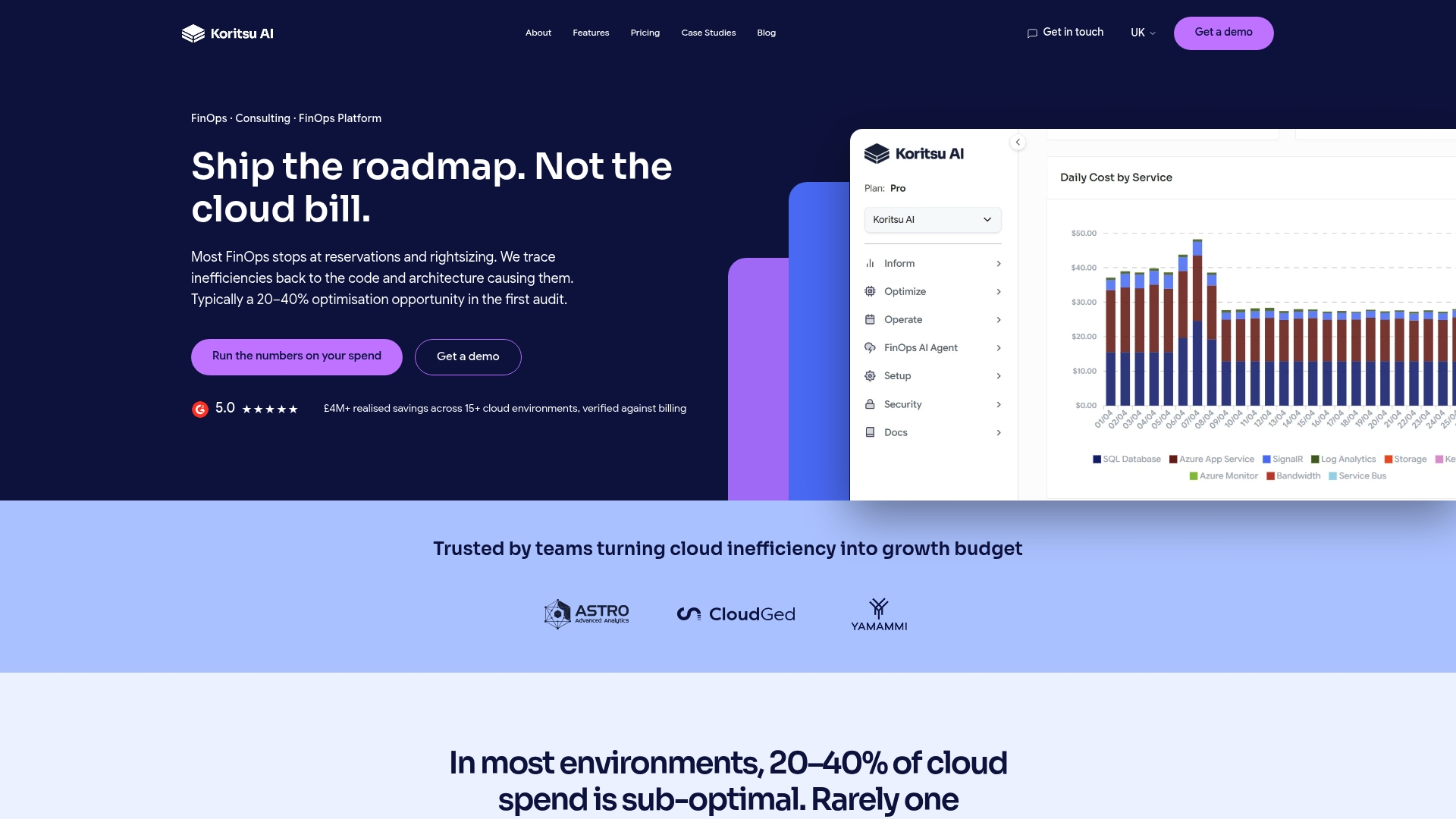
The starting point is a free assessment. Kori, Koritsu’s AI agent, surfaces where money is being lost across your AWS, Microsoft Azure, or Google Cloud Platform environment — including egress costs, proprietary service dependencies, and committed-use exposure. Specialists then help your team act on the findings: contract clause recommendations, a prioritised migration roadmap, and a lock-in liability model ready for your finance team or board. Koritsu AI only charges when savings are delivered, taking a share of what is actually found. There is no upfront fee and no long-term subscription required to get started. If you want to understand your lock-in exposure before your next renewal, start with a free assessment and see what the numbers actually say.
Useful sources and further reading
The sources below are the most useful for UK technology and engineering leaders working on cloud portability, egress cost reduction, and contract negotiation.
- GOV.UK: Managing technical lock-in in the cloud — the primary reference for UK public sector and regulated organisations; covers procurement language, portability requirements, and supplier management. Best for: procurement language and regulatory context.
- ISC2: Cloud exit strategies and avoiding vendor lock-in — practical security and architecture perspective on exit planning. Best for: technical exit planning and risk framing.
- Upsun: The real cost of hyperscaler dependency — covers egress fee mechanics and AI workload cost exposure. Best for: egress cost benchmarking and financial case-building.
- Atonement Licensing: Cloud vendor lock-in — detailed treatment of contractual mechanisms, egress waivers, and negotiation tactics. Best for: contract clause language and negotiation preparation.
- Datastorage.com: Cloud portability best practices — covers S3-compatible storage alternatives and egress reduction patterns. Best for: storage architecture and egress mitigation.
- EaseCloud: Avoiding vendor lock-in while optimising multi-cloud costs — multi-cloud cost optimisation tactics and governance habits. Best for: operational governance and multi-cloud ROI.
- Core.cz: Vendor lock-in prevention for enterprise — prevention-versus-remediation framing with enterprise context. Best for: board-level justification and prevention ROI.
- Codelit: Multi-cloud architecture strategy — Kubernetes, Terraform, and open format adoption guidance. Best for: platform architecture and tooling decisions.
- Azure: Free data transfer out when leaving Azure — Microsoft’s current egress waiver policy for organisations leaving Azure. Best for: egress negotiation reference and provider comparison.