FinOps Inform
Cloud automation for engineering leaders: a practical guide
Discover how automation cloud computing helps UK engineering leaders deploy faster and reduce costs. Start your journey with our practical guide.

Cloud automation is the practice of using software tools and APIs to provision, configure, and manage cloud resources with minimal human intervention, shifting operations from ticket-based workflows to a fully API-driven model. For UK engineering leaders, the verdict is straightforward: teams that automate their cloud operations deploy faster, recover from incidents more quickly, and spend less on idle infrastructure than those still relying on manual processes.
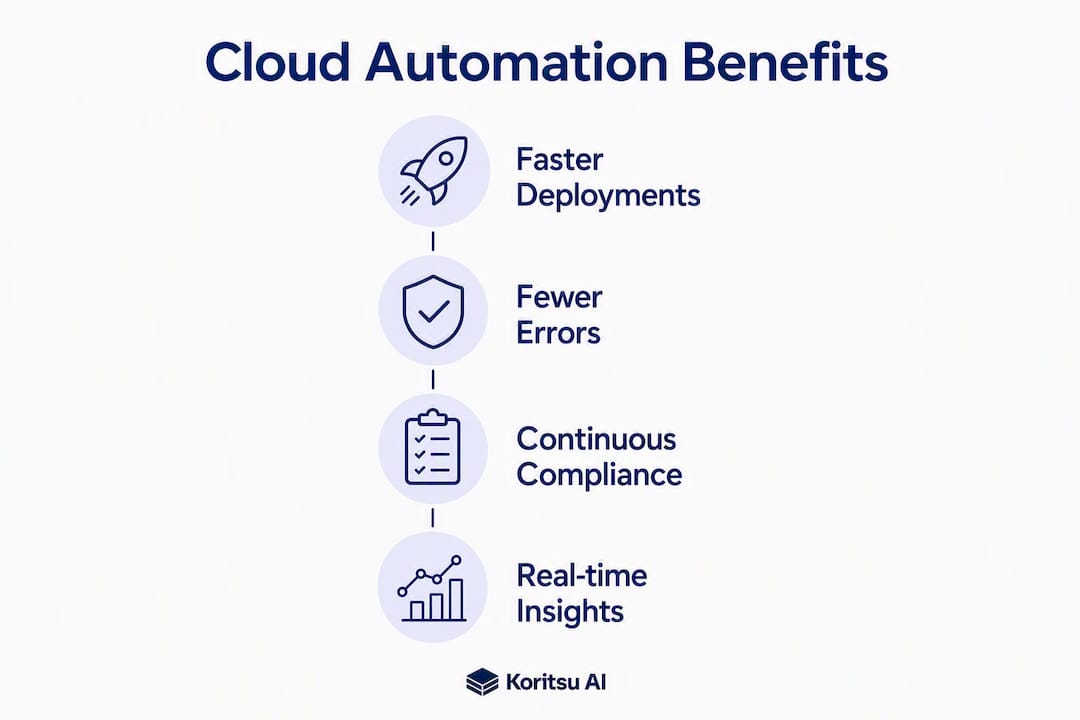
- Faster deployments and fewer human errors are the immediate operational wins; continuous compliance and real-time cost visibility are the strategic ones.
- Run a four-week pilot on a single use case, such as automated environment provisioning or rightsizing, before committing to a platform-wide rollout.
Pro Tip: Before writing a single line of Infrastructure as Code (IaC), define your policy guardrails using a tool such as Open Policy Agent (OPA). Automating without governance is the fastest way to scale a problem rather than solve it.
What role does cloud automation play in modern DevOps?
The primary role of automation in cloud platform operations is to remove humans from repetitive, error-prone tasks so engineering teams can focus on work that actually moves the product forward. That shift sounds obvious, but the organisational consequences are significant.

When provisioning, scaling, and configuration are handled by code rather than tickets, platform teams can offer self-service catalogues to developers. A developer who needs a staging environment no longer raises a request and waits two days; they trigger a pipeline and have a compliant environment in minutes. Cloud automation is a foundational platform-engineering strategy that enables exactly this kind of self-service developer experience while preserving governance, security, and cost guardrails.
The relationship with DevOps is direct. CI/CD pipelines depend on automated infrastructure to be reliable and repeatable. Without automation, a pipeline that works in one environment may fail in another because someone configured a dependency manually. Automation removes that variability. It also integrates naturally with FinOps: by enforcing policies and delivering real-time visibility into resource usage, automated cloud services reduce the risk of runaway bills that accumulate when engineers provision resources manually and forget to decommission them.
For UK teams running cloud environment management best practices, the operational shift looks like this: on-call engineers stop firefighting configuration inconsistencies and start improving the platform itself.
Automation vs orchestration: what is the actual difference?
Automation handles individual, repetitive tasks; orchestration sequences and schedules multiple automated tasks into end-to-end workflows, often across hybrid or multicloud environments. Conflating the two leads to choosing the wrong tool for the job.
- Use automation when the task is discrete and self-contained: spinning up a virtual machine, applying a security patch, or triggering a cost alert when spend crosses a threshold.
- Use orchestration when you need to coordinate the output of one automated task as the input to another: deploying an application requires provisioning infrastructure, configuring networking, running tests, and promoting the build, all in sequence and with conditional logic.
- Use both in a mature platform: automation handles individual tasks while orchestration coordinates them into workflows across hybrid environments, giving you speed at the task level and reliability at the workflow level.
A simple mental model: tasks become automation; workflows become orchestration; the combination becomes your platform. When you see a team struggling with brittle deployment pipelines, the root cause is usually orchestration gaps, not a lack of individual automation scripts.
What are the real benefits of cloud automation for UK engineering teams?
The primary business benefits are faster deployments, fewer human errors, continuous compliance enforcement, and real-time cost control. Each one compounds the others.
Deployment velocity improves because automated pipelines remove the manual steps that introduce delays and inconsistencies. Teams that previously released weekly can move to daily or on-demand releases once their infrastructure is codified and their pipelines are reliable. Fewer human errors follow directly: when configuration is defined in version-controlled code rather than applied by hand, the scope for accidental misconfiguration shrinks considerably.
Continuous compliance is where automation earns its keep for regulated UK industries. Policy-as-code tools enforce security and governance rules at provisioning time, before a non-compliant resource ever reaches production. That is a fundamentally different posture from auditing after the fact.
Cost control is the benefit that most UK CTOs underestimate until they see a billing spike. Automation supports FinOps by enforcing policies and offering real-time visibility into resource usage, which means idle or oversized resources get flagged and remediated automatically rather than accumulating charges for months. Pairing automation with a structured FinOps framework turns cost control from a quarterly review into a continuous operational discipline. For teams looking at concrete reduction techniques, reducing cloud infrastructure costs through automation is one of the highest-return starting points.
What are the main types of cloud automation you should know?
The six core categories are IaC, configuration management, CI/CD pipelines, autoscaling, policy-as-code, and AIOps. Each solves a different operational problem.
- Infrastructure as Code (IaC): Defines cloud resources declaratively in version-controlled files. Changes are reviewed, tested, and applied consistently. Tools in this category include Terraform, AWS CloudFormation, Azure Bicep, and Pulumi.
- Configuration management: Ensures that operating systems, packages, and application settings remain in a known, desired state across fleets of servers. Ansible is the most widely adopted tool in this space, with enterprise platforms designed to scale automation across hybrid estates under a single control plane.
- CI/CD pipelines: Automate the build, test, and deployment lifecycle so that code changes move from commit to production with minimal manual intervention. GitHub Actions, Jenkins, and ArgoCD are common choices.
- Autoscaling: Adjusts compute capacity in response to demand, preventing both over-provisioning and performance degradation. Cloud automation enables autoscaling and predictable configurations across hybrid environments, with orchestrators placing workloads onto nodes with the right capabilities.
- Policy-as-code: Encodes governance rules as machine-readable policies enforced at provisioning time. Open Policy Agent (OPA) and cloud-native equivalents prevent non-compliant resources from being created in the first place.
- AIOps: Applies machine learning to operational data, correlating signals across logs, metrics, and traces to surface anomalies and recommend or trigger remediation automatically.
Which use cases should UK teams prioritise first?
The three highest-return pilots for most UK engineering teams are automated environment provisioning, rightsizing and autoscaling for cost optimisation, and automated security remediation. These deliver measurable value within weeks rather than months.
- Automated environment provisioning. Replace manual, ticket-driven environment creation with IaC templates and a self-service catalogue. Time-to-value is typically two to four weeks. The outcome is faster developer onboarding, consistent environments, and a reduction in "works on my machine" incidents.
- Rightsizing and autoscaling. Identify oversized or persistently idle resources using billing data and apply automated rightsizing recommendations. Pair with autoscaling policies so capacity tracks actual demand. Automated cost alerts catch anomalies before they compound. Teams regularly find that a structured rightsizing exercise surfaces meaningful idle spend that had been invisible in aggregate billing reports.
- Automated security and compliance remediation. Use policy-as-code to enforce tagging standards, network access rules, and encryption requirements at provisioning time. Non-compliant resources are either blocked or automatically corrected. This use case is particularly valuable for UK teams operating under FCA, NHS Digital, or ISO 27001 obligations.
CI/CD pipeline automation and incident remediation via AIOps are strong follow-on use cases once the foundational IaC baseline is in place.
What challenges and risks should you watch for?
The central risk is that automation scales broken processes rapidly. A misconfigured resource created manually once is a nuisance; the same misconfiguration baked into an IaC template and applied at scale is an incident. Automating a broken process only scales inefficiency; success hinges on codified policies and clear ownership before you automate anything.
- Governance gaps: No defined ownership of automation code means no one is accountable when a pipeline creates non-compliant resources.
- Configuration drift: Without continuous reconciliation, environments diverge from their version-controlled desired state silently. Drift detection is not optional; missing it leads to cumulative divergence that undermines both security and cost controls.
- Insufficient testing: Automation code that is not tested before it reaches production carries the same risks as untested application code.
- Runaway cloud spend: Autoscaling without spend caps or budget alerts can generate unexpected bills. Policy-as-code guardrails and a cloud spending governance framework are the practical mitigations.
- Vendor lock-in: Heavy reliance on provider-native automation tools (CloudFormation, ARM templates) makes multi-cloud or migration scenarios expensive. Prefer provider-agnostic IaC where possible.
- Skills shortages: IaC, GitOps, and policy-as-code require skills that many UK teams are still building. Factor training time into every pilot estimate.
Red flags that a pilot is becoming risky: no version control on automation code, no automated tests in the pipeline, no drift detection configured, and no cost allocation tags enforced by policy.
How do you implement cloud automation in practice?
The recommended approach is pilot, then platform baseline, then scale. Trying to automate everything at once is how projects stall.
- Select a pilot use case (weeks 1–4). Choose a high-frequency, low-risk process: environment provisioning or automated tagging enforcement are good starting points. Define success criteria before you begin.
- Establish an IaC and GitOps baseline (weeks 4–12). Codify the pilot resources in Terraform or an equivalent IaC engine. Store all code in Git with branch protection and peer review. This is the foundation everything else builds on.
- Introduce policy-as-code (weeks 8–16). Add OPA or a cloud-native policy engine to enforce tagging, network, and encryption standards at provisioning time. Integrate policy checks into the CI pipeline so violations are caught before merge.
- Integrate CI/CD (weeks 12–20). Connect your IaC and application pipelines so infrastructure changes and application deployments are tested and promoted together. ArgoCD or GitHub Actions are common choices for GitOps-style continuous delivery.
- Configure drift detection and monitoring (weeks 16–24). Enable continuous reconciliation so the platform alerts on or automatically corrects any deviation from the desired state. Tie observability into your existing monitoring stack.
- Continuous improvement (ongoing). Review KPIs monthly. Expand automation coverage to new services and teams based on measured outcomes. A structured FinOps programme launch running in parallel accelerates the cost-control dimension.
The platform baseline phase typically takes three to six months for a mid-sized UK engineering team. Cost drivers include tooling licences, engineering time for migration and testing, training, and integration work with existing CI/CD systems.
Pro Tip: Version-control your policy-as-code alongside your IaC from day one. Teams that treat policies as an afterthought spend weeks retrofitting guardrails onto automation that was already running in production.
Which tool categories and patterns should you build on?
The main tool categories are IaC engines, configuration management platforms, CI/CD systems, GitOps controllers, policy engines, and observability and AIOps platforms. Modern cloud automation combines IaC, GitOps workflows, and policy-as-code to enable declarative, version-controlled operations with continuous reconciliation.

| Category | Primary purpose | Common interfaces | Typical outcome |
|---|---|---|---|
| IaC engines | Declare and provision cloud resources as code | HCL, YAML, TypeScript APIs | Consistent, repeatable infrastructure with full audit trail |
| Configuration management | Enforce desired state on OS and application layers | Agentless SSH, REST APIs | Reduced configuration drift across server fleets |
| CI/CD systems | Automate build, test, and deployment pipelines | Webhooks, Git triggers, REST | Faster, reliable releases with automated quality gates |
| GitOps controllers | Continuously reconcile cluster state with Git | Kubernetes API, Helm | Automatic drift correction in containerised environments |
| Policy engines | Enforce governance rules at provisioning time | OPA Rego, cloud-native SDKs | Non-compliant resources blocked before creation |
| Observability and AIOps | Correlate signals and trigger automated remediation | Metrics, logs, traces APIs | Faster incident detection and reduced mean time to recovery |
Architecture patterns worth adopting:
- Declarative with reconciliation: define desired state in code; let the platform continuously enforce it rather than running one-off scripts.
- GitOps: Git is the single source of truth; every change goes through a pull request with automated checks before it reaches any environment.
- Policy-as-code: governance rules live in the same repository as infrastructure code and are enforced in CI, not just at audit time.
- Centralised self-service catalogue: platform teams publish approved templates; developers consume them without needing to understand the underlying infrastructure. Automation supports hybrid and multicloud strategies by offering a single API or template approach across providers, which makes a centralised catalogue viable even in complex multi-provider estates.
How do you measure whether cloud automation is working?
The highest-value KPIs for an automation programme are deployment frequency, mean time to recovery (MTTR), cost saved, resource utilisation, drift rate, and policy violation count. Collect a baseline for each before the pilot begins; without a baseline, you cannot demonstrate improvement.
- Deployment frequency: how often code reaches production. Collected from your CI/CD platform. Rising frequency with stable error rates signals that automation is reducing friction without introducing risk.
- Mean time to recovery (MTTR): how long it takes to restore service after an incident. Automated remediation playbooks should reduce this materially within the first few months.
- Cost saved: the delta between pre-automation and post-automation cloud spend, adjusted for workload growth. Tie this to billing data and cloud cost unit metrics so you can attribute savings to specific automation initiatives.
- Resource utilisation: average CPU, memory, and storage utilisation across your estate. Low utilisation signals over-provisioning; automation should push this upward as rightsizing takes effect.
- Drift rate: the frequency with which live environments deviate from their version-controlled desired state. A rising drift rate is an early warning that reconciliation is not working.
- Policy violation count: the number of non-compliant resources detected per week. This should trend toward zero as policy-as-code matures.
Review these KPIs monthly and present them alongside billing data in your FinOps reporting cycle. Engineering metrics and financial outcomes belong in the same conversation.
A real-world example: Koritsu AI and a UK bidding platform
Koritsu AI's work with a UK bidding platform demonstrates what a focused automation and cost-control engagement can deliver. The platform was running significant production workloads on AWS and had no systematic process for identifying idle or oversized resources.
Koritsu AI's analysis surfaced architectural inefficiencies buried in how the platform's infrastructure had been built, not in the obvious discount or reserved-instance layer. Continuous monitoring and automated cost controls were introduced, and the platform achieved a significant reduction in cloud costs.
The intervention combined an initial cloud cost assessment to establish a baseline, followed by automated rightsizing, tagging enforcement, and anomaly detection configured to alert and remediate in near real time.
Three lessons from this engagement:
- The savings were architectural, not commercial. Discounts and reserved instances matter, but the largest inefficiencies were in how resources had been provisioned and sized.
- Continuous monitoring is what makes savings stick. A one-time rightsizing exercise without ongoing automation reverts within months as teams provision new resources manually.
- Governance must precede automation. Tagging policies and cost allocation rules were codified before automation was expanded, preventing the new automated processes from inheriting the old governance gaps.
Key takeaways
Cloud automation delivers its highest returns when governance, IaC, and continuous monitoring are in place before you scale, not after.
| Point | Details |
|---|---|
| Define before you automate | Codify policies and ownership rules first; automating a broken process scales the problem. |
| Start with a four-week pilot | Provisioning or rightsizing are low-risk, high-return starting points for most UK teams. |
| Drift detection is non-negotiable | Without continuous reconciliation, environments silently diverge from policy and cost controls fail. |
| Measure from a baseline | Capture deployment frequency, MTTR, and cost saved before the pilot begins so improvements are provable. |
| Koritsu AI accelerates the cost layer | A free assessment identifies architectural inefficiencies; the success-fee model means you pay only on verified savings. |
Why FinOps-aware automation is the only kind worth building
Most cloud automation guides treat cost as a secondary concern, something to address after the platform is running. That ordering is backwards, and it is why so many UK engineering teams end up with fast, reliable infrastructure that still generates unpredictable bills.
The teams that get the most from cloud automation are the ones that treat cost visibility as a first-class operational requirement from the start. That means tagging policies enforced by code, cost allocation rules built into the IaC baseline, and anomaly detection configured before the first automated pipeline runs in production. When those guardrails are in place, automation compounds the savings: every new resource provisioned through the platform inherits the governance rules automatically, rather than requiring a manual review after the fact.
There is also a people dimension that most technical guides underplay. Automation changes who owns what. Platform teams own the templates and policies; product teams consume them. That boundary needs to be explicit and agreed before the tooling is built, or you end up with automation code that nobody is accountable for maintaining. The governance side of cloud automation is a process problem, not a technology problem, and it is the part that most pilots skip.
Koritsu AI's approach pairs continuous AI-driven cost analysis with hands-on engineering support precisely because the technology alone is not enough. The platform surfaces where money is being lost; the specialists help teams act on it and build the governance structures that make the savings permanent.
Cut your cloud bill with Koritsu AI's engineering-grade approach
Most cloud cost problems are not solved by buying discounts. They are buried in how infrastructure was built and how it is managed day to day. Koritsu AI finds those inefficiencies and helps engineering teams fix them permanently, combining an AI platform that continuously monitors cloud spending with hands-on FinOps expertise.
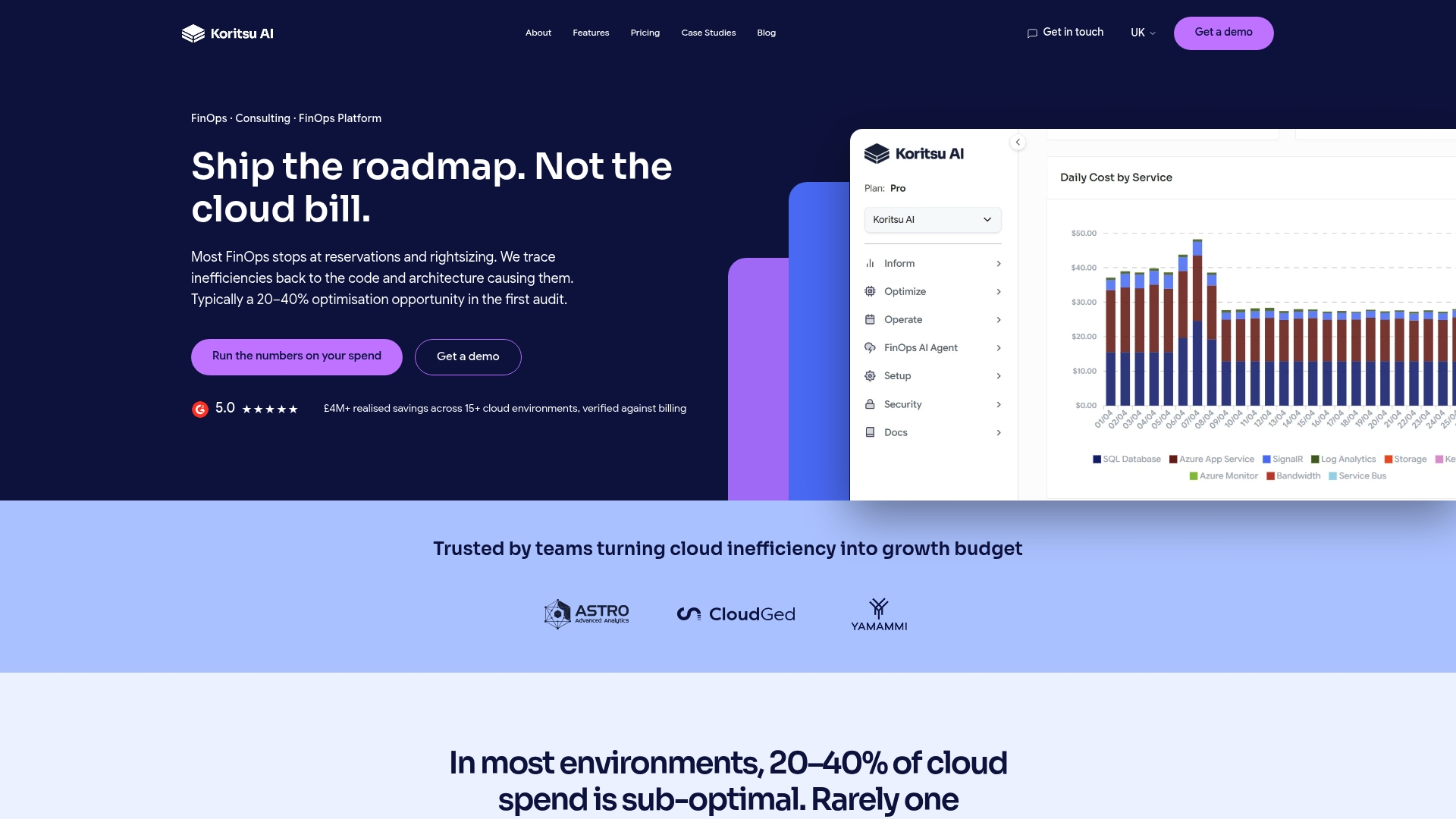
The engagement starts with a free cloud cost assessment. Koritsu AI's AI agent, Kori, analyses your AWS, Azure, or GCP estate and surfaces the architectural inefficiencies driving unnecessary spend. From there, the team helps you implement the automation controls, rightsizing, and governance structures that make savings stick. The commercial model is straightforward: Koritsu AI takes a share of the savings actually delivered, so there is no upfront fee and no risk of paying for advice that does not materialise.
The UK bidding platform case study shows what this looks like in practice: a significant reduction in cloud costs driven by architectural changes and continuous automated monitoring, not discounts. If your team is ready to move from manual cost reviews to a continuously monitored, automation-governed cloud estate, start with a free assessment to see where the savings are.
Useful sources and further reading
The sources below underpin the claims in this guide and are worth bookmarking for deeper reference.
Definitions and foundational concepts:
- What is Cloud Automation? | VMware — authoritative definition and platform engineering framing
- What is cloud automation? | Red Hat — automation vs orchestration distinction and governance principles
- What is Cloud Automation? | IBM — FinOps integration and hybrid/multicloud considerations
Tooling and patterns:
- Azure Automation | Microsoft Azure — Microsoft's cloud automation service documentation, useful for Azure-centric estates
- Red Hat Ansible Automation Platform — enterprise-scale hybrid automation capabilities
- What is cloud automation? | Intel — autoscaling and workload placement examples
FinOps and cost governance (Koritsu AI blog):
- Cloud FinOps framework benefits: a practitioner's guide — structuring FinOps teams alongside automation
- Cloud spending governance framework: a guide for CTOs — governance checklist and policy-as-code examples
- Cloud FinOps programme launch: your 8-week guide — practical timetable for pairing FinOps with automation pilots
- Benefits of automated cloud cost alerts for CTOs — automated alerting and remediation patterns