FinOps Inform
Why developer choices affect cloud bills
Discover why developer choices affect cloud bills. Learn how decisions on services, sizing, and architecture drive your cloud costs.

Your cloud bill is not primarily a procurement problem. It is a code problem. The decisions your engineers make every day — which services to call, how to size instances, whether to log at DEBUG in production, how microservices communicate — collectively determine far more of your monthly spend than any reserved instance discount ever will. Compute represents only 35–50% of total cloud costs for typical enterprise workloads; the majority of your bill comes from data egress, storage, managed databases, and monitoring.
Here is what actually drives that spend:
- Resource sizing decisions — overprovisioned instances run 24/7 whether traffic justifies them or not.
- Architectural patterns — microservices with chatty inter-service calls generate data transfer charges that simpler architectures would not produce.
- Data egress choices — serving large API responses or media files across regions can push egress to 20–40% of total spend in some workloads.
- Logging and monitoring levels — DEBUG logging in production feeds log ingestion pipelines that charge per GB ingested.
- Managed service selections — choosing a managed database or a serverless function trades operational effort for a cost premium that compounds at scale.
- Autoscaling configurations — poorly tuned scaling policies provision aggressively and release slowly, leaving over-capacity running long after traffic subsides.
- Lack of cost visibility — developers making infrastructure-as-code decisions without cost feedback unknowingly select expensive instance types that only surface on the bill weeks later.
The cost is not a technology problem. It is a process problem. And the fix starts with understanding exactly which behaviours are causing it.
How developer behaviour typically triggers cloud cost spikes
The pattern repeats itself across engineering teams of every size. Costs creep up slowly, then suddenly feel out of control, and by the time anyone investigates, months of compounded decisions are tangled together.
Common developer-triggered cost spikes include overprovisioned resources, forgotten idle services, excessive logging, and misconfigured autoscaling. Each one feels like a small, reasonable choice at the time.
- Overprovisioning — selecting an
m5.24xlargewhen anm5.xlargewould handle the workload, because no one checked the cost difference during code review. - Idle resources — development and staging environments left running over weekends; unattached EBS volumes accumulating storage charges after an instance is terminated.
- Excessive logging — enabling CloudTrail data events or verbose application logging without understanding that log ingestion, custom metrics, and storage costs compound silently across 15+ billing dimensions on services like CloudWatch.
- Misconfigured autoscaling — scale-out thresholds set too low, scale-in cooldowns set too high, resulting in a fleet that grows quickly and shrinks reluctantly.
- Microservice sprawl — architectures where a single API request triggers cascades of Lambda invocations, database queries, and inter-service calls. Each component is cheap in isolation; together they burn through budget on what should be a trivial operation.
- Cross-region data transfer — placing a web tier in one region and a database in another because it seemed geographically sensible, without accounting for the per-GB transfer charges that accumulate at volume.
- Managed service convenience costs — serverless functions and managed databases are easier to operate, but carry a cost premium that becomes material at millions of invocations or high transaction throughput.
Cloud billing complexity compounds all of this. AWS EC2 pricing alone varies by instance type, operating system, region, pricing model, tenancy, and data transfer direction. A developer estimating infrastructure for a new feature cannot simply look up “compute cost” — they need to know the specific configuration of every resource involved, plus the downstream charges those resources generate.
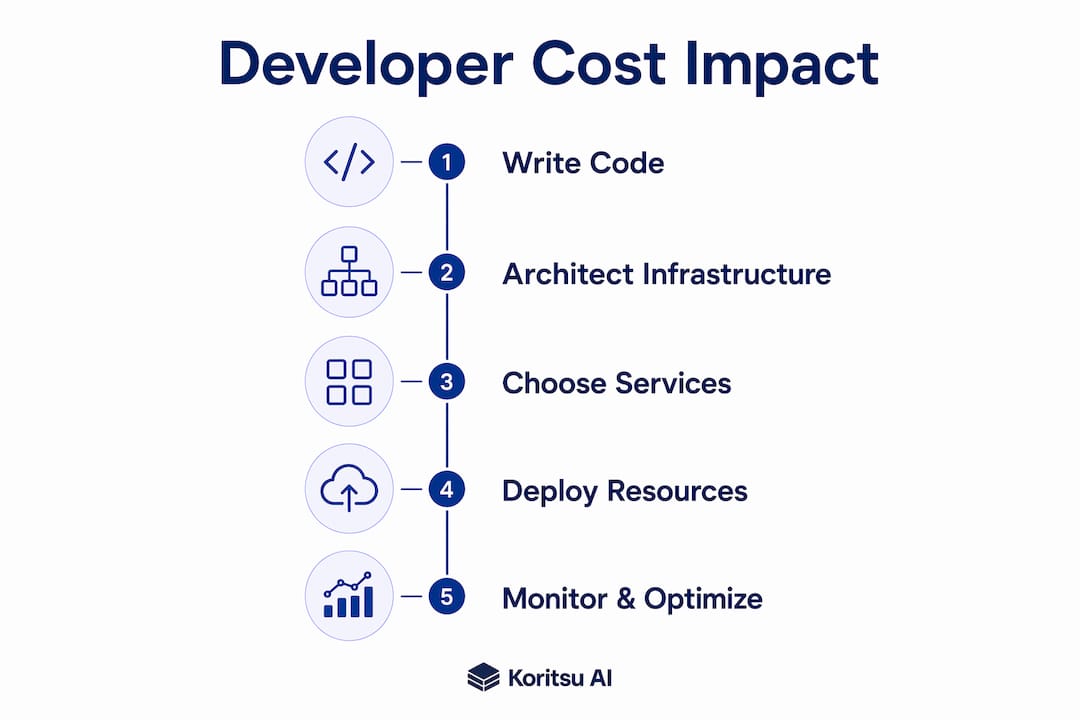
The architectural pattern question deserves particular attention. A monolith running on a single well-sized instance has predictable, contained costs. A microservices architecture distributing the same workload across dozens of services introduces network egress between availability zones, API gateway charges per request, and multiple managed service premiums. Neither pattern is inherently wrong, but the cost implications of the choice are rarely surfaced during the design phase. A practical cloud architecture cost review at the design stage catches these trade-offs before they reach production.

How to detect and diagnose cost spikes from development decisions
The hardest part of diagnosing developer-driven cost increases is that the connection between individual decisions and the overall bill becomes invisible once you have made 50 or more infrastructure changes over a few months. You can see the total went up. You cannot easily see which specific change caused it.
A systematic investigation approach cuts through that noise:
- Tag everything at the resource level — cost allocation tags applied to every resource (by service, team, environment, and feature) let you isolate which workload is responsible for a spike rather than hunting through aggregate billing data.
- Check egress first — sudden increases in data transfer costs are often the fastest signal. A new feature serving large payloads, a misconfigured CDN origin, or a cross-region database call can multiply egress charges overnight.
- Correlate billing anomalies with deployment dates — overlay your cost graph against your deployment history. A cost step-change that aligns with a specific release date narrows the investigation immediately.
- Examine logging and monitoring spend separately — monitoring and logging typically account for a small percentage of total cloud costs, but a single misconfiguration can push that much higher, but a single misconfigured CloudTrail Lake or verbose log group can push that far higher. Query your observability spend as a distinct line item.
- Review autoscaling activity logs — if your fleet is scaling out frequently but not scaling back, the autoscaling configuration is the likely culprit rather than genuine traffic growth.
- Audit idle and unattached resources — unattached storage volumes, stopped instances still incurring EBS charges, and forgotten load balancers generate costs with zero business value. A weekly idle-resource report surfaces these quickly.
- Map API call volumes — services like S3 and DynamoDB charge per request in addition to per-resource fees. High-volume request rates to services like S3 incur additional request charges separate from storage costs, independent of storage costs. High request volumes from a new feature are easy to miss until you look at the API call dimension specifically.
Understanding cloud pricing models — pay-as-you-go, reserved instances, spot pricing, and consumption-based pricing — is a prerequisite for this kind of investigation. Each model affects cost differently, and a spike that looks like a usage problem might actually be a purchasing model mismatch.
Pro Tip: When a cost spike is hard to attribute, pull your infrastructure-as-code commit history alongside your billing data. Matching the date of a Terraform or CDK change to a billing inflection point is often faster than working backwards from the bill itself.

Best practices to prevent developer-driven cloud cost overruns
Prevention is cheaper than remediation. Fixing a cost problem in production means change management, approvals, testing, and gradual rollouts. Catching it during code review means editing a single line. The CI/CD pipeline is where cost discipline pays its highest return.
- Treat cost as a first-class engineering metric — alongside performance, reliability, and security. If cost efficiency does not appear in your architecture review checklist or your definition of done, it will not be considered. The biggest cause of cloud cost inefficiency is ignoring cost as a first-class engineering metric, which leads to silent cost buildup across distributed systems.
- Right-size before you deploy — compare instance options explicitly during infrastructure-as-code review. Instance types vary significantly in monthly cost, with larger types costing more than smaller ones. That difference, multiplied across a fleet, is material.
- Set logging levels by environment — DEBUG in development, WARN or ERROR in production. Log sampling for high-volume services reduces ingestion costs without sacrificing observability.
- Conduct cost impact assessments at architecture review — evaluating new features for long-term operational cost during product planning prevents overruns that are expensive to fix post-deployment. Cost per customer or cost per transaction are the metrics that make this concrete.
- Configure autoscaling conservatively — set scale-out thresholds at genuine capacity limits, not comfort margins. Build scale-in policies that reclaim capacity within minutes, not hours.
- Avoid cross-region data transfer by default — co-locate services in the same region and availability zone unless there is a specific resilience requirement. Cross-zone transfer charges accumulate at high transaction volumes.
- Audit managed service choices explicitly — managed databases, serverless functions, and observability platforms are worth their premium in many contexts. The problem is choosing them by default rather than by conscious trade-off. Knowing the cost dimension of the choice is what matters.
Pro Tip: Add a cost estimate comment to every pull request that provisions or modifies infrastructure. Tools like Infracost integrate with GitHub and GitLab to generate per-resource cost breakdowns automatically. When developers see “this change adds £31/month” before merging, they make different decisions.
Embedding continuous cost awareness into development workflows
The shift-left FinOps approach moves cost feedback from the billing dashboard — where it arrives weeks after the decision — into the code review, where it arrives in seconds. Embedding cost estimation during code review significantly improves developers’ cost consciousness and prevents expensive production fixes later.
The workflow integration looks like this:
- Automated cost estimates in pull requests — infrastructure-as-code tools generate a cost diff for every proposed change, showing the monthly impact before the code merges.
- Cost budgets per team or service — cloud cost visibility by team creates accountability at the level where decisions are made, not just at the aggregate billing level.
- Cost gates in CI/CD pipelines — a pipeline step that flags changes exceeding a cost threshold for human review, analogous to a security scan or a test failure.
- Regular cost reviews in sprint retrospectives — treating a 30% cost reduction as seriously as shipping a major feature, because in terms of business impact they are often equivalent.
- Design-phase cost estimation — before writing code, estimate what a feature will cost to run at scale. An order of magnitude is sufficient: will this cost £100/month or £10,000/month? That number should inform the architecture.
The cultural shift matters as much as the tooling. Treating cost discussions as professional responsibilities, on a par with performance or security, motivates engineers to consider cost proactively rather than treating it as someone else’s concern. Finance sees the bill but cannot explain why data transfer costs tripled. Engineering understands the systems but lacks cost visibility. Closing that gap requires integrating cost feedback directly into the tools developers already use.
Integrating cost estimation into developer tools and code review workflows transforms cost from a finance problem into an engineering-first concern. The compounding effect is significant: every £100/month prevented is £1,200/year saved, permanently. Small decisions, made with cost visibility, compound into large savings over time. Non-compute costs — data transfer, storage, managed databases, monitoring — represent the majority of most cloud bills, and they are almost entirely determined by architectural and coding choices made long before the invoice arrives. Tools like Edgee and Capacity are worth evaluating for teams looking to surface these non-compute costs earlier in the development cycle.
Key takeaways
Developer and architectural decisions determine the majority of cloud costs, making cost awareness during code review the single most effective intervention available to engineering teams.
| Point | Details |
|---|---|
| Compute is a minority cost | Compute represents only 35–50% of total cloud costs; egress, storage, managed databases, and monitoring drive the rest. |
| Egress is the most underestimated line item | Data egress can reach 20–40% of total spend in workloads serving media or high-volume API responses. |
| Cost feedback must move left | Developers making infrastructure-as-code decisions without cost feedback unknowingly select expensive configurations that only surface weeks later. |
| Idle resources are pure waste | Unattached volumes, oversized instances, and forgotten load balancers generate charges with no business value and are straightforward to eliminate. |
| Cultural change precedes tooling | Treating cost as a first-class engineering metric, alongside performance and reliability, is the prerequisite for any tooling investment to deliver lasting results. |
How Koritsu AI helps engineering teams take control
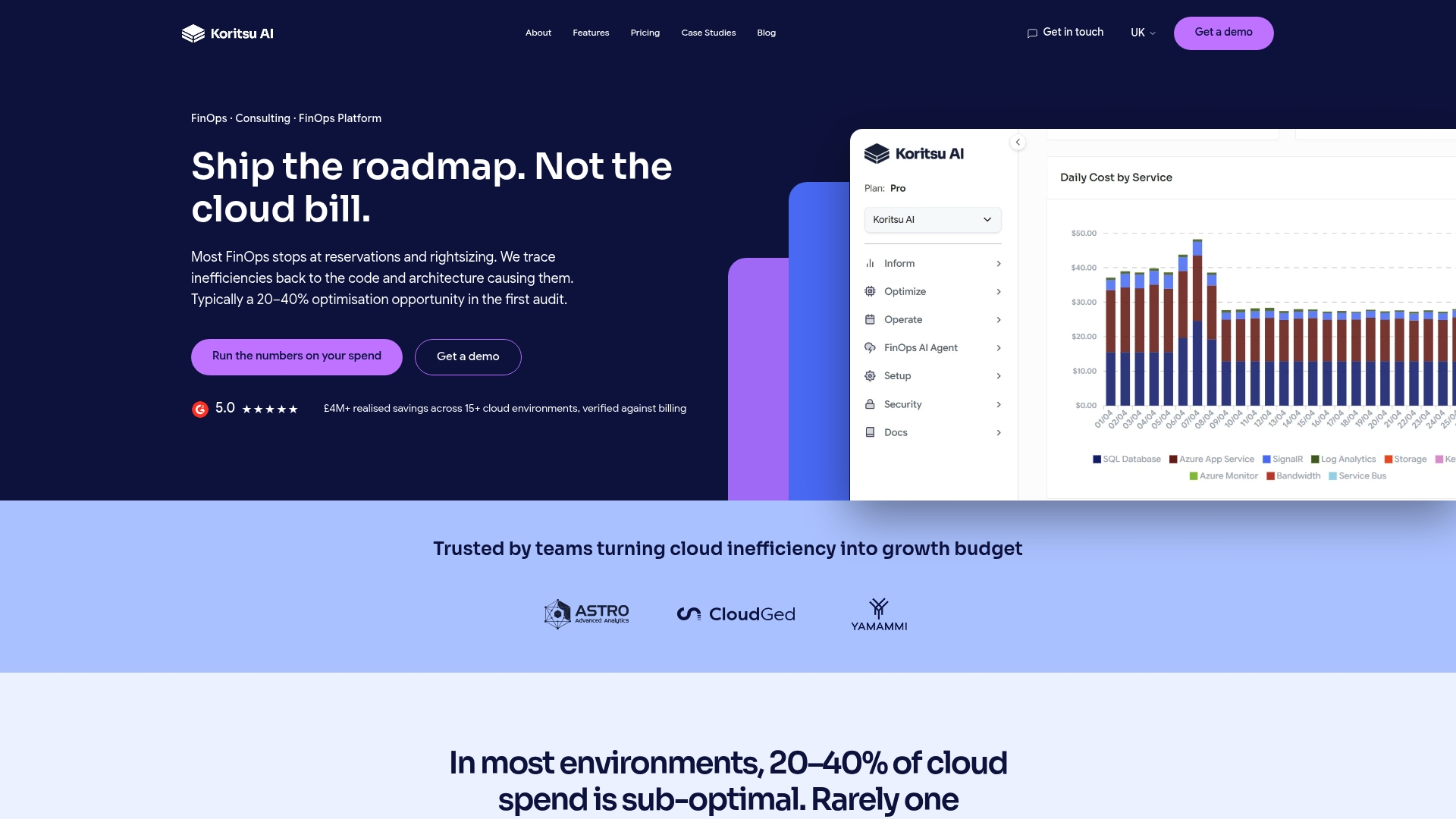
Most of the cost inefficiencies described in this article are fixable. They are not the result of bad engineering — they are the result of engineers making decisions without cost visibility. That is a process gap, and it is one Koritsu AI is built to close.
Koritsu AI combines a continuously running AI platform with hands-on expert advice. Kori, the AI agent, analyses your cloud spend across AWS, Google Cloud, and Azure, surfacing exactly where money is being lost and which architectural or coding decisions are driving it. Specialists then work with your engineering team to act on those findings. A UK bidding platform reduced its cloud costs by 52% through this process — not by buying discounts, but by fixing how the software was built.
There is no upfront fee. Clients start with a free assessment, and Koritsu AI takes a share of the savings actually delivered. If you want to understand what your developers’ choices are costing you right now, that is the place to start.