FinOps Inform
Reduce redundant cloud API calls: 2026 CTO playbook
Discover how to reduce redundant cloud API calls and cut costs in just 90 days with caching, batching, and coalescing strategies.

A combined programme of caching, request coalescing, batching, and conditional requests typically halves redundant API traffic within 90 days. The five highest-impact actions you can commission today are: cache identical GET responses in Redis (L1 in-memory, L2 Redis), add ETag conditional requests to your top endpoints so 304 responses avoid rate-limit consumption, implement single-flight request coalescing to collapse concurrent duplicates, batch small per-item calls at the gateway layer, and route simple or classification-type requests to cheaper backends or lower-cost models. Applied together across a production estate running OpenAI, GitHub REST API, or similar consumption-priced services, these patterns routinely cut API spend substantially within hours on the quick wins alone, with deeper savings accumulating over the 60–90-day window as architectural changes bed in. Koritsu AI's platform and Kori agent surface exactly which endpoints are driving spend before you write a line of code.
What should you tackle first to cut redundant API calls?
The table below maps actions to a 30/60/90-day window with example success metrics your engineering leads can track against baseline invoices.
| Window | Actions | Success metric |
|---|---|---|
| 30 days | Enable token reuse + single refresher worker; cache hot GETs in Redis; add ETag/If-None-Match to top-5 endpoints; centralise token refresh | Calls avoided per day; auth-endpoint call volume down |
| 60 days | Add request coalescing at gateway; instrument top-20 endpoints for cost and call volume; replace cron pollers with webhooks where feasible | Cost per endpoint per day; poller call count vs baseline |
| 90 days | Apply stale-while-revalidate to hot endpoints; add cost-aware CI tests; negotiate enterprise rate limits with documented usage data | % cost reduction vs baseline invoice; CI build failures on regressions |
30-day quick wins are almost always the highest return for the least engineering effort:
- Cache identical inputs in Redis; geocoding results alone can see 70–90% call reduction.
- Implement a single token-refresh worker to prevent auth storms during outages.
- Add
If-None-Matchheaders to your five busiest GET endpoints.
60-day medium work requires more coordination but pays back quickly. Instrumenting your top-20 endpoints by spend gives you the data to justify every subsequent change to your CFO. Gateway-side batching collapses many small calls into fewer large ones, reducing per-item overhead and auth handshakes.
90-day rollout is where architectural changes and governance lock in the gains. Cost-aware CI tests mean a future PR cannot silently reintroduce a polling loop or an uncached enrichment call.
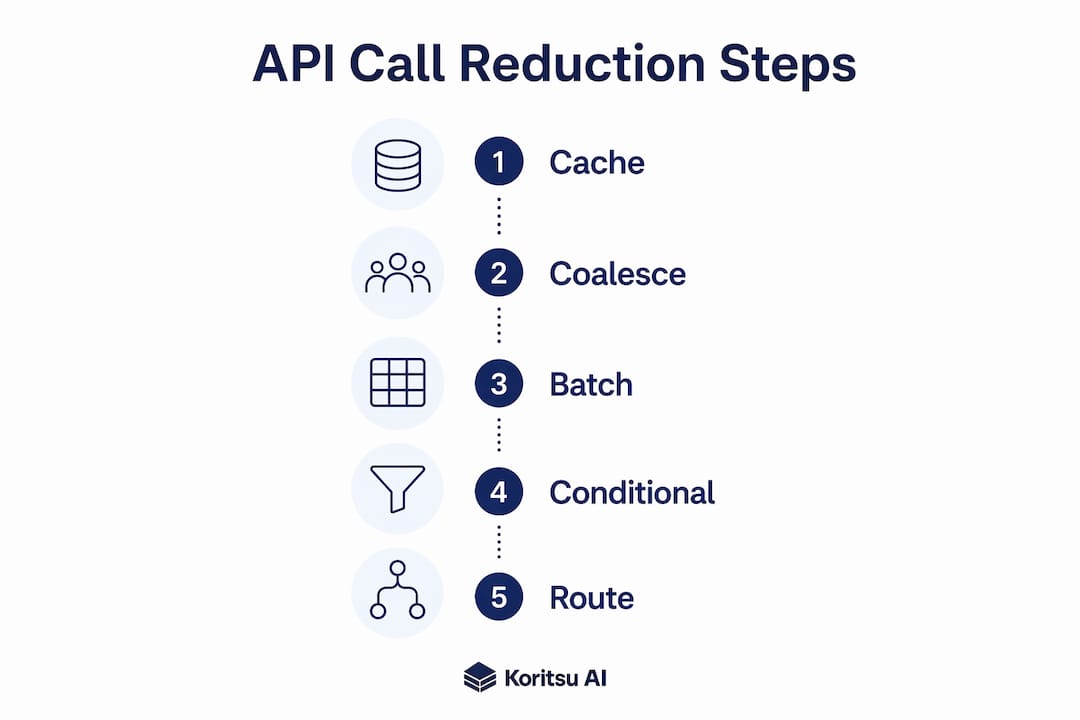
Core technical patterns that eliminate duplicate calls
Caching identical inputs: Redis L1/L2
The highest-leverage change for most teams is caching API responses and returning cached results instead of repeating upstream calls. An L1 in-memory cache handles sub-millisecond lookups for the hottest keys; an L2 Redis layer handles distributed access across service instances. TTL strategy matters: set value-aware TTLs (longer for slow-changing reference data, shorter for pricing or availability), and apply stale-while-revalidate so a stale response is served immediately while a background refresh runs. Semantic caching extends this to LLM calls, returning cached responses for queries that are semantically equivalent even when the wording differs.

Request coalescing (single-flight)
Where multiple concurrent requests arrive for the same resource before any response returns, coalescing intercepts them and issues a single upstream call, then fans the result back to all waiters. Implementations report orders-of-magnitude reductions in database hits and rate-limit failures versus naïve concurrent requests. The critical rule: never coalesce writes. Coalescing is for idempotent GETs and read-heavy enrichment calls only.
Pro Tip: Combine coalescing with caching so that the first coalesced response is immediately written to cache. Subsequent requests after the coalescing window closes hit the cache rather than triggering a second upstream call, protecting against thundering-herd stampedes.
Conditional requests and ETags
Send If-None-Match with the stored ETag on repeat GETs. When the resource is unchanged, the server returns a 304 Not Modified with no body. On the GitHub REST API, 304 responses do not count against primary rate limits. The Google Calendar API uses ETags for both retrieval and modification. The bandwidth saving is immediate; the rate-limit saving depends on the provider, but it is worth testing on every high-frequency endpoint.
Batching and aggregation
Batch multiple requests into single calls at the gateway or adapter layer. The OpenAI Batch API offers substantial cost reduction for asynchronous processing, ideal for document enrichment or overnight classification runs. Where provider bulk APIs exist, use them: embedding 2,048 texts per request rather than one at a time eliminates per-request overhead at scale. For writes, micro-batch with idempotency keys to avoid duplicate processing on retry.
Model routing for AI calls
Not every OpenAI call needs GPT-4o. Route classification, extraction, and lookup tasks to cheaper models. The cost differential between GPT-4o and GPT-4o-mini is significant, and for tasks that do not require maximum capability, the quality difference is negligible. A model routing layer that selects the cheapest model meeting the quality threshold per task type is one of the fastest ways to reduce per-request cost without touching application logic.
Architecture changes and provider tactics that go further
Replace polling with event-driven design
Cron-loop polling is an anti-pattern. Production pollers that cannot be replaced immediately should use adaptive intervals with cursors, jitter, and RFC-compliant 429 handling. Where webhooks are available, switch. Amazon's SP-API Notifications API is a direct example: instead of polling for order changes, your application receives events when specific conditions are met, eliminating entire polling loops.
Gateway and adapter patterns
- Centralise a single token-refresh worker so no service independently hammers the auth endpoint.
- Route simple, deterministic requests to cheaper backends; reserve expensive model calls for tasks that genuinely require them.
- Implement a unified API gateway that handles batching, coalescing, and caching in one place, rather than duplicating logic across services.
- Apply distributed rate limiting using Redis INCR+EXPIRE or a sliding-window token-bucket so multiple service instances share a single rate-limit budget.
Negotiating enterprise rate limits
Providers respond to data. Before any negotiation, collect:
- Current call volume per endpoint, broken down by service and feature.
- Growth trajectory over the past 90 days.
- Topology: how many service instances share the limit.
- A pilot plan showing what you have already reduced and what you are requesting.
Bring telemetry to the conversation, not estimates. Measured usage and a clear growth plan materially improve the outcome when requesting higher sustained quotas. The Koritsu blog on enterprise contract negotiation covers the documentation structure in detail.
How do you measure savings and verify them against billing?
Verification against invoices is the only way to confirm that engineering changes have produced real cost reduction, not just lower log counts.
Baseline metrics to capture first
- Calls per endpoint per day (and per user where applicable).
- Cost per call, calculated from provider pricing and call volume.
- Top-20 endpoints ranked by total spend.
- P95 and P99 latency per endpoint.
Instrumentation approach
Wrap every external API call to record service, endpoint, user ID, estimated cost, duration, and whether the response was served from cache. Export these metrics to your observability platform and link them to billing-period totals. The cost attribution guide covers how to break this down per microservice.
| Validation step | What to check |
|---|---|
| Before/after invoice reconciliation | Compare billing-period totals before and after each change |
| Cache hit rate | Confirm cache is serving the expected proportion of requests |
| Retry rate monitoring | Alert if retries exceed 5% of requests (each retry is a duplicate cost) |
| Canary or A/B pilot | Route a percentage of traffic through the new pattern before full rollout |
Cost-aware CI tests
Write tests that assert on cost behaviour the same way you write latency budgets. A test that fails a build when a dashboard page load triggers an AI API call, or when a repeat scan analysis does not return a cached result at zero cost, catches regressions before they reach production. These tests are the most durable guardrail against future engineers inadvertently reintroducing expensive call patterns.
Operational rules and guardrails that make gains permanent
Policy without enforcement reverts. These controls keep the savings in place.
Policy checklist:
- Mandatory caching for all GET endpoints in the top-20 by spend.
- Reviewed batching for any operation that previously ran per-item.
- Enforced idempotency keys for all write operations that may be retried.
- Per-user daily spend limits implemented in Redis to prevent runaway costs from a single user or job.
SLO and alert examples:
- Maximum calls per user per hour: alert at 80% of threshold, hard-stop at 100%.
- Cost-per-feature budget: alert when a feature's daily API spend exceeds 2× its 30-day baseline.
- Retry rate: alert if retries exceed 5% of total requests for any endpoint.
- Cache hit rate: alert if it drops below the established baseline for a hot endpoint.
CI/CD guardrails:
- Cost-aware tests that fail builds when call counts exceed defined thresholds.
- Automated PR checks for any new third-party integration, flagging estimated call volume and cost before merge.
- Pipeline cost gating so deployments that would increase API spend by more than a defined percentage require explicit sign-off.
Team processes:
- Runbooks for incident mode: flip enrichment flags off, increase cache TTLs, drain non-urgent queues.
- Assigned ownership for each gateway adapter so there is a named engineer accountable for its call behaviour.
- Quarterly cost audits reviewing the top-20 endpoints and comparing against the previous quarter's baseline.
How Koritsu AI and Kori accelerate verified savings
Koritsu AI combines a continuous monitoring platform with hands-on FinOps expertise. Kori, the AI agent, analyses your cloud billing and telemetry to surface exactly which endpoints and services are driving redundant spend, ranked by cost impact. You get prescriptive recommendations, not a dashboard to interpret yourself.
The engagement follows the 30/60/90 structure above: a free assessment to establish baseline, a pilot phase where the highest-impact changes are implemented and verified, and an ongoing subscription for continuous monitoring and governance. Savings are verified against invoices before any fee is charged.
A UK bidding platform worked with Koritsu AI and achieved a 52% reduction in cloud costs. The savings were verified against billing, not estimated from telemetry alone.
The case study details the specific patterns applied and the billing verification process. Request a free assessment to see what Koritsu AI's audit surfaces in your estate.
Key takeaways
Caching identical GET responses in Redis, adding ETag conditional requests, and implementing single-flight coalescing are the three changes that deliver the fastest, most measurable reduction in redundant API spend.
| Point | Details |
|---|---|
| Cache first, always | Redis L1/L2 caching of identical inputs cuts repeat call volume immediately, with geocoding and enrichment endpoints seeing the largest gains. |
| ETags save rate-limit budget | 304 Not Modified responses do not count against primary rate limits on GitHub REST API and similar platforms, reducing both cost and throttling risk. |
| Coalescing prevents stampedes | Single-flight request coalescing collapses concurrent duplicate calls into one upstream request, protecting against thundering-herd failures. |
| CI tests lock in gains | Cost-aware tests that fail builds on call-count regressions are the only durable guardrail against future engineers reintroducing expensive patterns. |
| Koritsu AI verifies savings | Koritsu AI's platform identifies top-spend endpoints and verifies cost reductions against invoices, not just telemetry estimates. |
Redundant calls are an architectural failure, not a billing quirk
Most engineering teams discover their API cost problem on the invoice, not in the code review. That is the wrong order. Every redundant call is a symptom of a decision made earlier: a polling loop added for convenience, a caching layer skipped to ship faster, a token refresh duplicated across three services because no one owned the shared worker. The bill is just the accumulation of those decisions at scale.
The fix is cultural as much as technical. API cost needs to sit alongside latency and error rate as a first-class performance metric. When a PR adds a new third-party integration, the cost per call and expected call volume should be in the review, not discovered six weeks later. When an incident fires, the runbook should include flipping enrichment flags and increasing TTLs, not just restarting pods.
The immediate action: run a top-20 endpoint audit this week. Surface the results to procurement before your next provider negotiation. The data changes the conversation.
Useful references and further reading
- GitHub REST API: best practices: Official documentation covering ETag behaviour and how 304 responses interact with rate limits.
- Conditional Request pattern (api-patterns.org): Canonical pattern reference for If-None-Match, 304 Not Modified, and provider examples including GitHub and Google Calendar API.
- shared-call-py: request coalescing for Python: Open-source implementation of single-flight coalescing with benchmark data on DB-hit reduction.
- API polling best practices (TaskJuice): Adaptive poller techniques including cursors, jitter, and RFC-compliant 429 handling.
- Reducing API chattiness and cost (Midways Cloud): Tactical guide covering batching, stale-while-revalidate, token reuse, and incident-mode playbooks.
- API cost optimisation guide (APIStatusCheck): Practical strategies for caching, batching, model routing, and cost-aware CI with code examples.
- Koritsu AI: common cloud API cost mistakes: Anti-patterns that cause redundant calls and engineering fixes for each.
Koritsu AI: the recommended next step for your team
Most of the redundant API spend we see at Koritsu AI was not the result of bad engineering. It was the result of good engineers moving fast without cost visibility. The patterns in this article are well-established; the gap is usually knowing which endpoints to fix first and having the instrumentation to prove the saving landed.
Koritsu AI's platform gives your team continuous visibility into API call costs by service, feature, and endpoint. Kori surfaces the highest-impact changes ranked by verified saving potential. The engagement starts with a free assessment, and fees are taken only as a share of savings confirmed against your actual invoices. There is no upfront commitment and no ongoing subscription until you have seen the results.
If you are managing significant production workloads on AWS, Azure, or GCP and your API spend is growing faster than your revenue, request a free assessment and see what Kori finds in your estate within days.